
[Join our Catch On teleconference Bible study this Wednesday night at 7pm PDT (10pm Eastern) by dialing (218) 237-3840 and using access code 124393#. To listen to a recording of last Wednesday’s session, dial (218) 237-3850, enter access code 124393# and the recording number: 090711#. Be sure and download the following workbook to review and get ready for next week: Catch On Study Guide – Introduction and Session.]
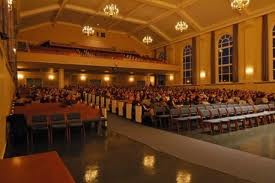 On September 12, 2001, the day after 9/11 and ten years ago, today, I spoke in the student chapel service at Gordon College In Wenham, Massachusetts. I can remember I was pumped because I knew what to say. My prophetic gift was in full bloom (and there is no arrogance in that statement because it is exactly that – a gift. I cannot claim any credit for it.) I can’t remember what I said, but I couldn’t wait to say it. Give me the platform; I came for this.
That sense of destiny was heightened by the fact that I got there after driving five days across the country delivering my daughter’s car to her. She was a transfer student at Gordon that semester and needed her car to commute off campus. Normally, I would have gotten off a plane from somewhere else for an appearance like this, and wondered where I was for a while. This time, five days and 3,000 miles under my tires told me. All that, and being the first one to address the whole student body after the horrific attacks the day before, added to the prophetic sense of appointment.
That, and having my daughter in the audience.
But the story of that day that has been with me longer that any of the details surrounding it was the fact that Anne (pronounced “Annie”) refused to take chapel credit for hearing her father speak.
Most conservative Christian colleges have daily or semi-weekly chapel, and in order to guarantee students attend, they typically have some form of recording their attendance as chapel credit and require a certain attendance quota each semester in order to remain a viable student. Most colleges do this electronically via a chapel card students swipe on their way into the auditorium. Anne attended, but refused to swipe her card. For Anne, this was no big deal, and just seemed to her like the right thing to do. For mostly anyone else, this would be a novel blow to legalistic Christianity, and something that might be useful to some of you in a wider application.
I happen to know, from being a recovering Pharisee, that legalism is almost impossible to disengage from religion or from what we commonly consider our spiritual life. From childhood we are programmed to perform, and performance has to be measured. So one way to kick the habit is to intentionally refuse to give yourself credit for anything spiritual i.e. don’t swipe your chapel card.
Refuse to give yourself credit for reading the Bible because it’s your Father’s words you are reading. Refuse to give yourself credit for going to church because it is your Father you are meeting there. Refuse to give yourself credit for praying because it is your Father you are talking to. Refuse to give yourself credit for introducing people to Christ because it is your Father you are speaking about, and it is good, right and natural for you to speak to anyone about family.
It’s that simple. Anne had it right. Turn in your chapel card. In fact, tear it up. This is your Father we are talking about here, and loving and honoring him can’t and won’t be measured.






 John Fischer The Catch
Yesterday our pastor taught on Luke 15:11-32, which I had always understood to be the Parable of the Lost or Prodigal Son. He gave credit to Timothy Keller’s book, “The Prodigal God”, in pointing out that if you look at the audience in vv 1 – 3, this parable was intended for the Pharisees (yeah, me included.)
Luke 15:1 Now the tax collectors and “sinners” were all gathering around to hear him. 2 But the Pharisees and the teachers of the law muttered, “This man welcomes sinners and eats with them.” 3 Then Jesus told them this parable: …
So, Jesus told the story of the lost sheep, then the lost coin, and the parable of the two sons started innocuously enough with a lost son who repents. All is fine until Jesus points his finger at the proud older son who had his whole act together and lived his life perfectly, just like the Pharisees, and then publicly insulted his father by refusing to go inside to join the celebration. You got it. It was the older son’s pride that kept him from entering into the banquet feast and the joy of his father.
Ouch!