
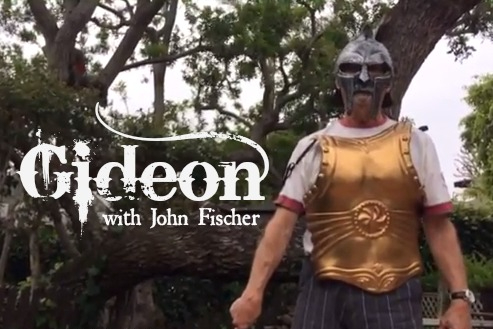
That night the Lord said to Gideon, “Take the second bull from your father’s herd, the one that is seven years old. Pull down your father’s altar to Baal, and cut down the Asherah pole standing beside it. Then build an altar to the Lord your God here on this hilltop sanctuary, laying the stones carefully. Sacrifice the bull as a burnt offering on the altar, using as fuel the wood of the Asherah pole you cut down.” (Judges 6:25-26)
Before any of us can go out and do mighty things for God in the world, we have to take care of what’s going on at home. Before we can defeat the enemy that is encamped about us, we must deal with the one that already wormed its way into our household. There’s no way God is going to give Gideon victory over the Midianites while the false god, Baal, sits smugly atop the place of worship in his father’s house, where someone might even think it was by the power of the idol that the victory was won. No way.
And yet this is such a common reality. Indeed, for many who have experienced success outside the home, the tendency is to become more and more involved “out there” and pay less and less attention to what is going on “in here,” because what’s going on in here isn’t going so well. How can I expect God to entrust His wider family to me when I’m letting my own family go at home?
Our idols are not as obvious and clearly defined as Gideon’s, yet our idols are quite prolific. Indeed, our idols can be virtually anything. Anything we return to for comfort, power, insight — things God supplies to us freely — is an idol because it has taken over the place of God. For instance, one of my idols is the Ignore button. I press it whenever anything becomes too difficult for me, and by doing that, I supplant God who is available to empower me to do the difficult thing. The Ignore button has to come down.
Think about what (who) you go to for comfort. Find that which gives you a false sense of power and makes you think you’re smarter than everyone else, and you’ve probably found an idol in your house that needs to come down. Believe me, we’ve got lots of them.
So Gideon took ten of his servants and did as the Lord had commanded. But he did it at night because he was afraid of the other members of his father’s household and the people of the town. (Judges 6:27)
When you knock down an idol, you find out that’s all it was — an idol. Not the real thing at all. It’s powerless; that’s how you can knock it down. The only power idols have is the power we give them in our lives. Take them down and they are nothing.
Gideon got no argument from the idol. Tearing it down was a relatively easy job; he and his servants accomplished it all in one night. Cutting up the wooden Asherah pole only showed that it was made up of nothing but firewood — excellent fuel for an offering to the true God of Israel. The resistance came from the people of Gideon’s family who had given these idols of stone and wood significance in their lives. We have a psychological word for this: it’s called codependency.
When we knock down one of our idols, we will undoubtedly receive resistance from those close to us who have made adjustments to that idol in their lives as well. Just like Gideon’s family, they will have to decide what they are going to do without that idol in the house. The point is, it will create an environment that calls for a greater dependence on God, and that is where we all want to be.
CLICK ON THE BANNER FOR THE NEXT VIDEO!







 John Fischer The Catch
And could it be that the first Israelite to be freed from the bondage of the Midianites was Joash, the father of Gideon? While our sharpest and most caustic push back can come from within our own families, we must endure the shaming for their benefit. Gideon’s bold obedience to God in destroying and supplanting his father’s pagan altar gave Joash an opportunity to put his own god Baal to the test. “If he is a god, let him contend for himself, because his altar has been broken down.”
When Baal failed to respond, Joash was freed.
God wants all of us and don’t need to be tied to something even halfway like an idol. When God sent his Son Jesus because He so loved the world it was a complete task to save all of us. We don’t need to ever depend on some idol halfway when our God went
all the way to save each of us forever.