‘But I tell you…’

th-11Now begins a section in the teaching of Jesus (Matthew 5:21-48) where six times He says, “You have heard it said…” which is followed by, “But I say…” It is clearly a reinterpretation of the law for the benefit of the Pharisees, and anyone else who thinks they can follow it.

For the purpose of grasping what Jesus is doing here, I’m going to summarize all six, because you get the full impact when you take them all at once. Remember, this immediately follows, “For I tell you that unless your righteousness surpasses that of the Pharisees and the teachers of the law, you will certainly not enter the kingdom of heaven.” In other words, if you want to use the law to get into heaven, this is what you will have to do and not do.

You have heard… Do not kill anyone.
But I say… Anger or hatred in your heart is the same as murder.

You have heard… Don’t commit adultery.
But I say… Lust in your heart is the same as adultery.

You have heard… Don’t divorce without a certificate.
But I say… Divorcing and marrying another is adultery, too.

You have heard… Don’t break your oath.
But I say… Don’t make an oath, because you will break it.

You have heard… Eye for an eye, and tooth for a tooth.
But I say… Don’t retaliate; turn the other cheek; go the extra mile; lend to the one who wants to borrow.

You have heard… Love your neighbor and hate your enemy.
But I say… Love your enemies; pray for those who persecute you. If you greet only your own people, what are you doing more than others?

Well now, based on this, let’s see how we measure up. As far as I’m concerned, after just one day… say, yesterday… I killed a few people, committed adultery numerous times, broke a few oaths, at least wanted to retaliate, and had a few unloving thoughts toward a perceived enemy or two. That’s five out of six I broke, and the only reason I wasn’t a 100% failure was because I didn’t happen to get divorced and remarried yesterday, but, of course, I was already guilty of adultery, anyway, so that hardly counts in my favor.

And what is the point of all this? What is Jesus doing here? He’s showing me, and any other Pharisee like me, that to “be perfect as my heavenly Father is perfect” is completely beyond me to do. And if I’m hoping I might please God or get into heaven by being a pretty good guy … I better think again.

Posted in Uncategorized | Tagged , | 2 Comments

Impossibly following Christ

The teaching of Jesus we’ve been following in Matthew continues with this:

Do not think that I have come to abolish the Law or the Prophets; I have not come to abolish them but to fulfill them. For truly I tell you, until heaven and earth disappear, not the smallest letter, not the least stroke of a pen, will by any means disappear from the Law until everything is accomplished. Therefore anyone who sets aside one of the least of these commands and teaches others accordingly will be called least in the kingdom of heaven, but whoever practices and teaches these commands will be called great in the kingdom of heaven. For I tell you that unless your righteousness surpasses that of the Pharisees and the teachers of the law, you will certainly not enter the kingdom of heaven. (Matthew 5:17-20)

th-10At first, this looks like really bad news for us, but in fact, it is truly great news. The greatest news ever. Jesus is merely saying, “There’s nothing wrong with the law; the problem is with you. None of you can follow it. And the Pharisees are in the worst way because they think they can.”

If you want to be accepted by God on the basis of your behavior — if you want to be justified by the law — then you better make sure you obey it perfectly. If you’re going to base your spiritual life on being good, then you’d better be perfect. Otherwise, you’re not going to make it.

Well, that leaves us all out. Precisely. The law leaves us all out so that Christ can let us all in by His grace and mercy. The only ones who don’t get in are the ones who think they can earn their way in by following the law. This is why Jesus, in the next few verses, is going to make the law even harder — in fact impossible — to follow. He’s going to try and save them the trouble. He’s going to show how hatred in your heart is really murder, and lust in your mind is really adultery.

The law is good; we are not.

Now, as Jesus says, the law doesn’t go away. He didn’t abolish it; He fulfilled it, so that our only chance of approximating what God expects of us is through Christ in us. This is why, once you are a Christian, you can’t then go back to trying to be good without realizing your incompetence and relying on His power for everything. Believe me, I know about this, because I keep trying to pull off changes in my life and forgetting I can’t do it without relying on Him.

This is why the standards and expectations on our lives remain high — indeed impossible — so that only through Christ can they be realized. And it’s a continual realization: I can’t possibly do this; on the other hand, I can impossibly do this in Christ.

It’s going to take grace to save us; it’s going to take grace for us to follow.

Posted in Uncategorized | Tagged | 3 Comments

Walk and talk

leighton-and-wranglerTonight, we are privileged to have on our BlogTalkRadio show an old friend and spiritual mentor, Leighton Ford. Leighton has a long and illustrious career: as an evangelist with the Billy Graham Association, of which he served as Vice President; and as Honorary Life Chairman of the Lausanne Committee for World Evangelization, having served from 1976 to 1992 as chairman of this international body of Christian leaders; and as a mentor to leaders through his own Leighton Ford Ministries.

I first met Leighton in 1970 when someone suggested I might be a good person to help him reach the youth in his crusades. Using pretty much the Billy Graham model, an advance team would go into a city that wanted to sponsor a crusade and mobilize the churches into doing all the advance work finding volunteers to serve as ushers, counselors and singers in the choir. During the crusade itself, they would sign me up to do assemblies in the local high schools, and, sort of like a pied piper, I would invite them to come to the crusade, focusing especially on Youth Night when I would sing at the crusade as well. Though I was barred from preaching the gospel in those assemblies, I would pretty much let the songs do that, like linking “I Can’t Find My Way Home,” by Blind Faith with “Come on people, all come home/Jesus gonna make you well,” by Arlo Guthrie.

We’ll talk a little about all that stuff tonight, but what I really want to talk about is what he is doing now, which is mentoring young leaders through a ministry he has built called The Mentoring Community. He discusses this in a 60-page booklet available for free on his website.

In perusing that little booklet, what impresses me is the priority place upon relationships and the time to build them; walking and talking time — time for reflection and time to drink deeply from the well of life.

Maybe it’s just me right now, but that all seems like a luxury to me. When can I find the time to walk and talk? Whether I get even one of them done or not, I feel at all times like I have a hundred and one things to do. I don’t have time to walk and talk.

And then I think about life and what it’s for, and if it isn’t for walking and talking, then what are we doing? What am I doing that is more important than the people in my life? And how will I ever introduce the Gospel of Welcome to anyone if I don’t have the time or the opportunity to walk and talk with them?

Hopefully, Leighton can help me with this, and you as well. Tune in tonight (click on banner below), live, at 6 pm Pacific (9 pm Eastern), or if you can’t listen live, any time after that you can listen On Demand at the same link.

dlf

Posted in Uncategorized | Tagged , | Leave a comment

Hiding in the light

Location! Location! Location!th-9

It’s what they say will sell houses, but here Jesus is pushing our location as the way He wants to bring light to the world. Once again, this verse is not about what we do as much as it is about where we are. Get out where your light will make a difference. Be a city on a hill. Come out of hiding.

I once heard about a plan to build a huge state-of-the-art medical center in Tulsa, Oklahoma, staffed entirely with Christians. From doctors down to janitors and parking lot attendants, everyone working there would be a Christian. Think about the healing that could be offered in such a place. Think about the brilliant light that place would put out to the surrounding community with all those Christians in one place!

But then think about who would go there, and you soon realize that, for the most part, the patients would be Christians too. Such a place might be just a little too creepy to the unbeliever. How quickly it would become a safe haven for Christians. No one would ever have to be confronted with anyone different than themselves. You can easily see how quickly such a place would be not a place to encounter the world, but to hide from it.

Years ago I was privy to a private study on the best customers to some of the most successful Christian bookstores in the country — who they were and why they went there. The results were overwhelming. They were all Christians, and they went to the Christian bookstore to escape the world. They completely trusted the store to provide only that which was good for them, and they stayed as long as they could, because they felt safe there. If they bought a book while they were there, it wasn’t to read it; it was their price of admission for the experience of being in a safe place.

Both the hospital and the bookstore are examples of what happens when we get around too much light. You might think all that light would have a great affect on the culture, but in fact, the opposite is true. The same goes for Christian music, television, schools and such. They become not places to influence the culture as much as to hide from it. It’s like hiding in the light. There’s so much light around you, you don’t even have to worry about shining. Your little light hardly makes a difference anyway.

The whole point of being the light of the world is to bring light into the darkness. No th-4wonder that hospital never came to be; God wanted all those doctors, nurses, janitors and parking attendants spread out all over the surrounding cities and towns where their lights would mean something, because it would be dark without them.

Are you in such a place? Then rejoice; you are where you should be. Your light is going to shine just by being there.

Posted in Uncategorized | Tagged | 4 Comments

Getting out there

You are the light of the world. A town built on a hill cannot be hidden. Neither do people light a lamp and put it under a bowl. Instead they put it on its stand, and it gives light to everyone in the house. In the same way, let your light shine before others, that they may see your good deeds and glorify your Father in heaven. (Matthew 5:14-16)

th-6What this part of the teaching of Jesus doesn’t say is almost as important as what it does say.

It doesn’t say “Be the light of the world,” or “Be the salt of the earth.” It doesn’t even say, “Go shine your light.” It says “Let your light shine.” It’s the passive sense of the verb. The point of the verse is not to make your light shine; it’s to get yourself out of hiding to a place where your light (that you already have) can do some good.

The important thing is not shining your light; it’s being who you are where you put yourself. The light is assumed. Your light is already shining. We are the light, just like we are the salt. We are these things by nature of what we believe and who indwells us. Get yourself out from under that place where you are isolated, and get yourself out into the world. Put yourself out where your life can make a difference.

This is why the Christian subculture has been so detrimental to the spread of the gospel. The Christian subculture has been like a big “Christian” bubble under which Christians have been hiding safe from the world. Indeed, one of the main motivating forces behind the rise of the Christian subculture has been to provide a safer alternative world to the world we live in. But what good is that? What good is light all together in one place? Get your light out into the darkness where it can shine where there is no light. What good is salt in a salt shaker? Same deal. Spread yourselves around where you can do some good.

This is why our relationships are so important. The Gospel of Welcome spreads by way of relationships, but it is limited by us. It can’t go anywhere if we don’t go anywhere. It spreads through us to the world by way of relationships. Your light isn’t this little glow on the top of your head; your light is in you, and it is seen and known as you come alongside people and walk and talk with them. Your light is seen as through a natural course of events as people get to know you.

This teaching is critical to the vision and purpose of the Catch Ministry. If we’re going to introduce the Gospel of Welcome to everyone, everywhere, we’re all going to do the introducing. That’s what every Catch is designed to do … to get us out there and in relationship, walking alongside, being salt and light, because that’s what we already are.

th-8

Posted in Uncategorized | Tagged | 1 Comment

‘Light up those halos’

201409180137058412083You are the light of the world. A town built on a hill cannot be hidden. Neither do people light a lamp and put it under a bowl. Instead they put it on its stand, and it gives light to everyone in the house. In the same way, let your light shine before others, that they may see your good deeds and glorify your Father in heaven. (Matthew 5:14-16)

“Light that baby up!” they say whenever the Los Angeles Angels win a game, and last night was no exception as the Angels beat the Seattle Mariners and became the 2014 American League West Division Champions. The “baby” they are referring to is a halo atop a 230-foot sign in the shape of a big “A” that is illuminated following games in which the Angels win (both home and on the road), giving rise to the expression, “Light up the halo!”

But last night, there wasn’t the typical piling on in the middle of the baseball diamond that traditionally accompanies the final out of a major league championship game. That’s because the final out of the Angels game didn’t seal the championship. It was the final out of a come-from-behind victory by the Texas Rangers 500 miles north in Oakland, almost an hour later, that sealed the deal. And for this, at least a third of the Angels fans had stayed, knowing that an Oakland Athletics loss meant the celebration could begin.

And begin it did, with the whole team coming back on the field after donning their 2014 AL West Division Champions T-Shirts and hats, along with a new addition to the celebratory gear: ski goggles, to protect their eyes from the traditional champagne bath that accompanies these landmark victories. They looked like scuba divers surfacing out of their dugout, and circling the stands slapping high fives with fans and spraying them with champagne.

All of this lasted almost until midnight, but it was worth it to see the players, accompanied by their wives, children and in some cases parents, all joining in with the fans for one grand celebration of no small feat that took 152 games to accomplish.

Some of you were probably knowing I would want to write about this victory, and wondering how I would work it into a Catch. Well it’s pretty easy knowing that the next part of the teaching of Jesus is His identifying us as the light of the world — that light, of course, being the light of Christ in our lives.

But far from the self-righteous hypocrisy that accompanies usual references to pious halos, these are rather unholy halos we wear, knowing that along with being the light of the world, we are still the salt of the earth. The halo of Christ is balanced out by the saltiness of our everyday lives and our human foibles. That’s why it’s fitting that these two go together.

So remember that today — that you are not only the salt of the earth, you are the light of the world, so “Light up those halos,” everybody, Christ is our light!

th-3

Posted in Uncategorized | Tagged , | 5 Comments

Salty dog

You are the salt of the earth. But if the salt loses its saltiness, how can it be made salty again? It is no longer good for anything, except to be thrown out and trampled underfoot. (Matthew 5:13)

I always thought that what Jesus meant when He said we were the salt of the earth must go something like this:

You are the salt of the earth
You are what gives life flavor
You are the non-boring part of human existence
You are why I made peopleth-1
You are the grit
The rub
You are not top dog — I’m top dog
You are salty dog

You are not complete
You are unfinished — rough
You are poor in your soul
And hungry and thirsty
And hurting
And low to the ground
You are falsely accused
And misunderstood
But your heart is pure
You seek peace
And you welcome anyone
Because you are the salt of the earth

Don’t try to be what you’re not
Then you won’t be salty anymore
Salt that is not salty?
Whoever heard of such a thing?
Salt that is not salty is useless.
It’s lost its grittiness
It’s lost its taste
It’s diluted
Boring
You are there, but you’re not
You don’t change anything
You serve no purpose
You have no personality
You might be refined
But you’re not salty
So what good are you?

You are the salt of the earth
You flavor this existence
You preserve this thing called life
You are not perfect, but you are the point
You are the meaning
You aren’t perfect, but you’re salty
And I like you that way
You old salty dog

Posted in Uncategorized | Tagged | 3 Comments

Changing the world from below

th-15In his book The Myth of a Christian Nation, Gregory A. Boyd argues that legislative power and the kingdom of God operate on two completely different levels. One exerts a power over people as it seeks to amass public opinion, gain votes and change structures of government, but the kingdom of God works on a power under basis — it is based on serving and lifting people up.

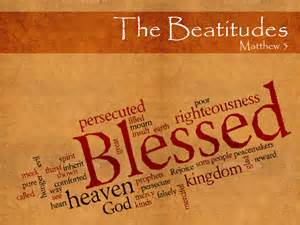
That power under form of bringing change to the world is best exemplified by the teachings of Jesus summed up here in these Beatitudes we have been studying. Blessed are the poor in Spirit; those who mourn; those who hunger and thirst for righteousness; those who show mercy because they need mercy; those who quietly make peace; and those who are persecuted, misunderstood and falsely accused, for these people walk in the kingdom of God. These are all power under attitudes and attributes that are God’s way of changing the world. We change the world by connecting our own need to the needs of others and helping them before we help ourselves.

By the way, the kingdom of God — sometimes referred to as the kingdom of heaven — is not the same as heaven. The promises made in these Beatitudes are not fulfilled some day far off somewhere; they are fulfilled now. Jesus already proclaimed that the kingdom of God had come. He brought it; and through His Spirit, we can walk in it.

Jesus didn’t come as a political king to set up His rule and change the world by decree; He humbled Himself, became a servant and suffered and died, and that power under is now loosed in our lives by the Holy Spirit. He changed the world by example. We change the world by following Him.

“Now that I, your Lord and Teacher, have washed your feet, you also should wash one another’s feet” (John 13:14). Washing His disciples’ feet was the ultimate display of a power under way of changing the world. And Jesus commanded His disciples to do the same. We are His disciples too if we do what He has asked us to do.

This is the way the Gospel of Welcome advances in the world — through each one of us as we serve the needs of those around us. The gospel is not spread by decree or by mass media (power over), it is spread by coming alongside and lifting people up, one by one (power under).

Think of some ways you can exert some power under today. Whose needs can you connect to today, and how can you serve them? When we use whatever resources we have to better someone else’s life, we are stepping into the kingdom of God. When we connect our need to the needs of others, we become a part of God’s solution. This is how we change the world.

Posted in Uncategorized | Tagged , | 3 Comments

Blessed are the needy

Blessed are those who are persecuted because of righteousness, for theirs is the kingdom of heaven. Blessed are you when people insult you, persecute you and falsely say all kinds of evil against you because of me. Rejoice and be glad, because great is your reward in heaven, for in the same way they persecuted the prophets who were before you. (Matthew 5:10-12)

th-12These last of the “Blesseds” have to do with bad things that happen to you because you are following Christ. These apply to us, but not to the degree that they did to the early Christians, many of whom were martyred for their belief. Nor do they apply to us as they do right now in parts of the world where people are suffering intense persecution — some losing their lives — because of their faith in Christ.

Sometimes Christians try to apply this blessing to themselves when it is not because of Christ they are suffering, but because they are being fanatical, or they have to be 100% right all the time, or they are pushing their values on society and getting “persecuted” as a result. That doesn’t count. This doesn’t say, “Blessed are you when you are persecuted for being insensitive.” It has to be because of Jesus, not because of us.

It’s really justice Jesus is talking about here. Blessed are you when you are unjustly treated because of me. I notice. I will set that straight. Leave your case with me.

Here’s the thing you can’t help but notice about all these “Beatitudes” or blessings Jesus lays out in this, His earliest teaching. They are not — any one of them — anything we would naturally consider a blessing. The poor in spirit, the mournful, the meek, the unrighteous, the merciful, the innocent, the maligned and misunderstood … these are those who are blessed. Oh really? Doesn’t look like it on the surface.

Jesus is evening the score. He is raising up the lowly and bringing down the proud. It is for us to realize this and focus on our need, because that will always lead us to our inheritance in the kingdom of God.

What is Jesus doing here, if He’s not turning our value system on its head? We tend to set aside the successful, the popular, and the wealthy as those who are blessed. Nothing could be further from the truth.

The teachings of Jesus necessitate a new way of thinking.

Let’s just say, generally, that the needy are those who are blessed, and that means needy in every sense of the word. Are you sensing your need today? Are you needing mercy, righteousness, comfort, peace, innocence, and justice? Consider yourself blessed. It is our need that tethers us to Christ. That’s when He becomes our only resource, and that’s why we end up blessed: We end up with Jesus.

Posted in Uncategorized | Tagged , | 3 Comments

What God did

IMG_3856Yesterday, in the hospital where she works as a Physician’s Assistant in orthopedic trauma, my daughter was repairing a tendon in the finger of a man when she found out he was a guitar-playing pastor. So she asked him if he had heard of me. “YOU’RE DAD IS JOHN FISCHER?” he exclaimed, a little too loudly for anyone’s comfort – his enthusiasm undoubtedly bolstered by the morphine she had administered. “I’M A CHRISTIAN TODAY BECAUSE OF YOUR DAD!”

Now, how cool is that? Not that I did anything, but that I got to find out about it. That’s what’s unusual about this story. Getting to find out about what God did.

Actually I didn’t do anything here specifically in relation to this guy. I just did what I do. Had this encounter never happened, I would not have known anything about this. That’s because God did this; it’s His secret formula for spreading His truth and getting things done eternally.

This is true for every one of us. There are people whose lives have been touched forever in some way by you, and you don’t know anything about it. That’s because the affecting of a life is not because of what we do; it’s what God does through us while we are doing everything else, that will change the world.

I know I can say with confidence that whoever you are, whatever you do, God has and will touch someone through you. I know this because this is what God does. He uses all of us, and it seems to be mostly when we don’t even know it, or aren’t even trying. We are all pieces of the puzzle that, when fit together, tells the story of God’s redemption of the human race. Someday you might find out what God did because of you, but that’s not important. What’s important is that God did it.

And now I know of a man who can still worship God with his guitar today because of my daughter, and that’s pretty cool, too.

Following is a piece by Marti that gives a window into the mystery of how God works. This is how we see ourselves as God uses us in the world.

So what is true prayer? 

by Marti Fischer

To some who were confident of their own righteousness and looked down on everybody else, Jesus told this parable:

Two men went up to the temple to pray, one a Pharisee and the other a tax collector. The Pharisee stood up and prayed about himself: “God, I thank you that I am not like other men-robbers, evildoers, adulterers-or even like this tax collector. I fast twice a week and give a tenth of all I get.”

But the tax collector stood at a distance. He would not even look up to heaven, but beat his breast and said, “God, have mercy on me, a sinner.”

I tell you that this man, rather than the other, went home justified before God. For everyone who exalts himself will be humbled, and he who humbles himself will be exalted. (Luke 18:9-14 NIV)

The tax collector’s prayer incorporates little; he recognizes himself as the lowest, worse kind of being – a sinner, and, as a sinner, he realizes he will never be any better in and of himself.

There is no account of him adding: “But … a sinner of merit, or a sorry sinner, or a reformed sinner because I am going to be different from now on, or an honest sinner because I am willing to tell you the whole thing, or a praying sinner as I humble myself before you.”

He proposes no joint ventures: “Lord, I have a part that I can contribute which you desperately need, and I am willing to invest my two cents in this enterprise if you will do the rest.”

Rather he recognizes that he has absolutely nothing to contribute to God’s cause. He is praying out of utter bankruptcy.

He begs, “God, have mercy on me, a sinner.”

He is not prideful, trusting in his own abilities rather than trusting God, nor is he regarding other people with contempt and disrespect, nor is he praying to himself about himself, nor is he laying before God his faithful service or casting himself wholly upon God during emergencies only, nor suggesting that he is a marvelous blessing to God as the Pharisee did, “I thank you that I am not like other men – robbers, evildoers, adulterers – or even like this tax collector, nor does he point out what he has done for God as did the Pharisee, “I fast twice a week and give a tenth of all I get.”

The tax collector understands, as we must, that he has no abilities in himself. We, like the tax collector, never feel adequate to meet any situation apart from Jesus Christ. Prayer, therefore, is an expression of an awareness of helpless need that can only be met by God.

The tax collector comes from a place of apprehensiveness with a humble heart and simply begs for mercy before a holy God. He is aware that the only way he has access to God is through divine mercy (Daniel 9:18-19). Such access is not earned; it is the product of God’s grace.

Therefore, join other members of our Catch community, and me, as we beg, “God, have mercy on me, a sinner.”

Posted in Uncategorized | Tagged | 2 Comments