‘O my God, it found out me!’

And can it be that I should gain
An interest in the Savior’s blood?
Died He for me, who caused His pain-
For me, who Him to death pursued?
Amazing love! How can it be,
That Thou, my God, shouldst die for me?

This hymn by Charles Wesley has long been one of my favorites, and to understand its meaning you need to hear it a certain way. To hear it one way is to hear that last line without any real inflection. That Christ should die for me along with everyone else is a grand enough thought. But to make it even grander you need to add an embellishment on that last “me.” That Thou, my God, shouldst die “for ME?”… and the question mark is appropriate.

“ME?” meaning the least likely for anyone to love. “ME?” meaning the worst of sinners. “ME?” as in: “I can maybe see Him dying for somebody else, but not me.” Or as Paul says it in Romans: “Very rarely will anyone die for a righteous person, though for a good person someone might possibly dare to die. But God demonstrates his own love for us in this: While we were still sinners, Christ died for us” (Romans 5:7-8).

While we were still messed-up, lost, unlovely, unlovable, selfish, conniving jerks, Christ died for us! It’s preposterous! The idea is not only that you are messed up, but that you see yourself as more messed up than anybody else.

When you think about it, it makes sense. We should all think of ourselves as the worst sinner we know because … well … we don’t know anybody else well enough to make any comparison. I’m the worst sinner because I know my sin intimately. I don’t know your sin that well. I can’t even judge it. That’s not up to me, but I do know myself and I am amazed that “Thou, my God, shouldst die for me?”

I ran across a great statement yesterday on someone’s Twitter account and I apologize for stealing it, but I had to share it with you. “What makes the gospel offensive isn’t who it leaves out, but who it lets in.” And at the bottom of the list of who it lets in would be you (to you) and me (to me).

If there’s anybody you’d rather not have in heaven, then you need to check your Pharisee monitor, because that kind of thinking registers high on the Pharisee chart. If I think there is anybody out there worse than me, I’m engaging in wrong thinking.

Besides if there’s someone you don’t want in heaven because of something you don’t like about them, or something they’ve done to hurt you, just remember: whatever they’ve done, in heaven, will be gone.

We need to hold onto this perspective and never let it go. The person I should be most amazed about finding in heaven should always be me.

He left His Father’s throne above
So free, so infinite His grace-
Emptied Himself of all but love,
And bled for Adam’s helpless race:
’Tis mercy all, immense and free,
For O my God, it found out me!

Amazing love! How can it be,
That Thou, my God, shouldst die for me?

Posted in Uncategorized | Tagged , , | 11 Comments

Facing ourselves

I and I,
One says to the other,
No man sees my face and lives.
– Bob Dylan

When I heard that Philip Seymour Hoffman had died from an apparent overdose of heroine, my initial thoughts were about how an obviously intelligent man could do something so stupid. Then I read an article in New York magazine by David Edelstein, a journalist who had studied his work and interviewed him shortly after his brilliant role as Truman Capote in Capote, for which he won an Oscar, and I began to understand. Edelstein points out that “the only Hoffman characters at ease with themselves are the bad ones.” Hoffman learned to play the dark side of humanity – especially nuances of the dark side trying to cover itself up as illustrated in Doubt where he plays a conflicted priest who doesn’t believe he’s a sexual predator.

“I think deep down inside, people understand how flawed they are,” Hoffman said in the interview. “I think the more benign you make somebody, the less truthful it is.”

In this statement, Hoffman may have hit on what makes Christians seem so phony or at least gives us a reputation of being so. The more we go around as flawed people trying to be more benign, the more untruthful we will appear to others. The truth is we are all as deeply flawed as anyone else; we just don’t want to know that.

I often wonder if in this regard we misuse the new life doctrines of being dead to sin and alive to Christ as a coverup instead of a means of facing ourselves. A person who preaches they are dead to sin and alive to Christ without ever facing the sin they are dead to is someone who doesn’t fully know what they are talking about.

The blessed thing is that in the death and resurrection of Jesus who said he was the first fruits of those who believe (in other words, the first one to make it through this terror and come out whole on the other side), we find the means to face ourselves and not despair. There is a way out of our sinful selves, but that doesn’t mean we can avoid our sinful selves. Some people think that Romans 7, where Paul struggles with two natures, happens only once for the believer. I think it happens all the time. I believe in some form we have this struggle every day – the difference being, we always have a way out.

Lots of Christian doctrine can be used to avoid ourselves when, in fact, it was created by God to be a means of facing ourselves and not ending up like Philip Seymour Hoffman. These truths are a means of facing our darkest secrets and coming out with hope and new life, not a means of never having to face ourselves at all.

“I suspect Philip Seymour Hoffman had a lot of shame in his life and dealt with it by going deeper than any actor of his generation in finding its source,” Edelstein wrote. That is something you don’t want to do without the death and resurrection of Jesus Christ to bring you through.

Many of us who do have access to that hope have yet to put it to use.

SPECIAL GUEST: YOU!

Something a little different tonight on BlogTalkRadio. Marti and I will be hosting the show together and taking calls from any of you who would like to call in and ask a question or make a comment or just chat with us for a little bit. And if you’d rather not call but have a question or comment to submit simply reply to this email and we will be glad to address it on the air. We would love to hear from you so don’t hesitate to call.

CALLINbtr banner

Posted in Uncategorized | Tagged , | 12 Comments

In the world

th-3It’s easier to judge than to empathize. It’s easier to categorize than to identify. It’s easier to find what’s wrong with the world than it is to find and support what is right. It’s easier to write the world off as being truly messed up than it is to join the mess.

Jesus told us that He did not come into the world to condemn the world but to save it. I guess you could say Jesus was worldly. God so loved the world that He gave it Jesus, and even though the world rejected Him, He did not reject the world. He embraced it. He touched unclean lepers and women with “issues of blood” (something forbidden in the laws of Moses) and let prostitutes touch Him. He ate with sinners. He walked among the people freely without being a respecter of persons. He welcomed all who came to Him with a sincere heart – even Pharisees (Nicodemus and Simon). Christians need to start thinking and acting more like Jesus.

If you find yourself judging the world it’s a sign that you have removed yourself too far from it. You can’t judge what you embrace; you can only judge what you have distanced yourself from. Otherwise you are casting judgment upon yourself, and who’s going to want to do that?

We must say no to the temptation to judge, categorize and disengage from the world. The Christian subculture in America is largely the result of this desire to disengage. We behave as if we don’t like the world, and we’d like to create our own world where things are more the way we want them to be. We want to be safe. Sure, we’ll take the gospel to the world as long as we can return to our protected enclaves where the world is more distant. If we could create a heaven on earth, we would, and let the world go to hell. But thank goodness we can’t, because the world needs what we know. People need the Lord, and we act like we want to keep Him to ourselves? Not good.

We are representatives of the gospel of welcome. Though not of the world, Jesus was in it, and He welcomed any and all. Jesus didn’t have a safe place to go at the end of the day as if He was done being in the world for a while. Not once is there any evidence that Jesus wanted to remove people from the world. Death will do that soon enough. In the meantime, we are here to join, embrace, connect, engage – all the things Jesus did.

Daniel, one of our members, observed after yesterday’s Catch, “It is so much more attractive to feel the strength of anger and judgement and arrogance towards the world and others around us. How vulnerable and helpless it feels to be sad. Perhaps that is where God wants us. Desperate for Him.”

Yes: desperate for Him in the world. Desperate, bringing Christ to the desperate. Sinners, bringing Christ to the sinners. Hungry, bringing Christ to the hungry. Messy, bringing Christ to the mess. It’s what He came here for us here to do.

Are we in the world or just somewhere in the vicinity?

Posted in Uncategorized | Tagged , , | 11 Comments

John wept.

woman crying

Don’t forget her.

I got all choked up Tuesday on the radio. I was talking about Francis Schaeffer and why he cried and the depth of it gripped me and I cried, too. Couldn’t help it. Marti noticed it in my voice and asked me why. I couldn’t answer beyond the fact that it was something Schaeffer taught me to do.

Francis Schaeffer’s voice was high-pitched and shrill. I used to joke that because of his Philadelphia accent he sounded like Elmer Fudd on drugs. But the more I listened to it, the more I realized it was a cry. The whole delivery was a cry. I can still hear it.

With his “Line of Despair,” Schaeffer drew a box, climbed in it, announced that this was what reality looks like to modern man, and cried.

Jesus cried too. It’s the shortest verse in the Bible. We used to joke about it when we were kids in Sunday school because we got points for the number of verses we could memorize and recite. Everyone knew this one: “Jesus wept.” He cried for the same reason Francis Schaeffer did.

Jesus cried at the tomb of Lazarus. Why did he do that? He was about to raise Lazarus from the dead, for heaven’s sake. He was on the brink of one of His most triumphant moments. Why cry now? Because He looked around Him and saw the despair of the people, and the reality of their situation broke over Him like a 10-foot wave. He realized that when they put someone they love into one of these tomb things, that’s it for them. As far as they know they will never see that person again. That’s about as far away from Christ’s reality that you could get, but He went there and He felt it, and it was real – so real that He cried. It’s called empathy: the ability to understand and share the feelings of another.

My wife often tells a story about friends of ours who were in the hospital having a baby. In the middle of labor, the wife calls out that she is cold. The dimwit husband says, “Why? I’m not cold.” SO? WHAT DOES THAT HAVE TO DO WITH ANYTHING? GO GET A BLANKET, DUMMY! The world is lost without Christ and what do we say? “Well, I’m not lost.”

Jesus could have said, “I’m not in despair here. I’m about to bring your friend out of the tomb. What’s your problem?” But He didn’t. Instead, He drew a box, climbed in it, felt what reality looks like to the people around Him, and cried. It’s a beautiful scene.

It’s different now. People are not struggling with the same things as they were in 1969, but they’re still struggling. We went from modernism to postmodernity and now we’re beyond that and I’m not even sure what we call the basic philosophical reality of the current western mind, but one thing we do know that without God people are lost. It’s so simple. People need the Lord.

HOW COME WE DON’T HEAR THIS ANYMORE? HOW COME WE ONLY HEAR HOW SCREWED UP THE WORLD IS? HOW COME NO ONE’S CRYING ANYMORE?

Last week I called a bunch of people, including Jesus, communists, just to prove a point, and got 42 responses and almost lost one of our members. Two days ago I wrote about the same subject I’m writing about today – learning to cry over the lost – and not one comment. Come on, people … what’s wrong here?

Listen to John cry.

 Click here.

Posted in Uncategorized | Tagged , | 12 Comments

Learning from failure

Marti recently wrote the following, and I quote:

“And of course, it is in all of this that we learn that failure is not such a bad thing. While it is not a word that many of us know, it is what we fear the most. But from my point of view, failure is where I get my best material. I know that God finds this in me to be so.”

I purposely lifted this out of context from her writing because I wanted to be able to extrapolate on it. This is not the first time we’ve stated something like this at the Catch and I promise you it won’t be the last. In fact we have certain themes that repeat themselves often, and that is not because we don’t have enough “material,” it’s because these things run so counter to our natural way of thinking that we need to keep saying it over and over again in as many ways as we possibly can, because truth is like a prism with many faces, each reflecting something different about the same basic thing. And learning its lessons only comes through repeated experiences.

In this case the truth we’re learning is that failure is where we get our best material. Now this is true in many senses of the word.

For instance, a comedian would say his best material was his funniest, and this is also true about failure. There is a humor to failure – a humor that means the joke is on us, but that’s okay because in process of the joke we become human. We get into trouble when we take ourselves too seriously. We try to ride too long on our high horse. Failure brings us down to where everyone else is and where we should be if we were being honest with ourselves. There is a relief in this failure; we don’t have to try so hard. In fact, often the humor is in the trying, and the failure reveals that. It’s always a relief to get down off of whatever pedestal we had ourselves on and laugh at what we looked like up there. Duh … welcome to the human race, John.

In Philippians, Paul lists his Jewish pedigree: “circumcised on the eighth day, of the people of Israel, of the tribe of Benjamin, a Hebrew of Hebrews; in regard to the law, a Pharisee; as for zeal, persecuting the church; as for righteousness based on the law, faultless” (Philippians 3:5,6) and then he calls it all (expletive deleted) compared to the surpassing greatness of knowing Christ. There is definitely some good material there, humorously speaking.

Then there is another sense that failure gives us our best material because it produces something solid in us. It is thick, tangible, touchable, as in Madonna’s material world. Failure is where we get our best material because what we get comes from God. We don’t produce it; we only discover it in our failure. When we are weak, then we are strong. God’s grace is sufficient, but it only becomes sufficient in our insufficiency. In the new covenant, we discover our adequacy only when we face into our inadequacy. But in every case it is in our failures that God’s provision becomes real. It’s solid because we didn’t create it or manipulate it. “For we who are alive are always being given over to death for Jesus’ sake, so that his life may also be revealed in our mortal body” (2 Corinthians 4:11). There it is: life revealed. That’s solid.

And finally, failure gives us our best material in that it gives us something we can pass on to others. Because failure is a universal human experience …  what we receive from Christ in our failure is something we can always give to others in theirs. This is part of what brings us together, our mutual need.

So next time you face your own failure, relax. You’re going to get some great new material out of this!

Frank Schaeffer had to postpone his interview at the last minute last night but the resulting interview with Marti and me is well worth hearing on demand.

 Click here.

Posted in Uncategorized | Tagged , | 2 Comments

Learning to cry

th-1Few men have influenced me as greatly as has Francis Schaeffer, the late father of Frank Schaeffer, our BlogTalkRadio guest tonight. The elder Schaeffer was the first on a short list of evangelical leaders in my lifetime who were serious students of their culture.

Francis Schaffer’s books and lectures were lathered with secular novels, plays, and cinema and the world views represented therein. He was in many ways a voice crying in the wilderness because the evangelical world that spawned a subculture throughout the 1980s and even wrongly claimed Scheffer as their founder, largely rejected that model of conscious involvement in culture for one of a blanket rejection and the erection of an alternative, safer Christian culture with a head-in-the-sand approach to cultural involvement. My guess is that were Schaeffer alive today, he would have some serious head butting to do with those who claim him as their hero.

If Francis Schaeffer knew he would be considered the father of the religious right, he would claim that relationship was illegitimate. Check the DNA and you will find out Schaeffer is not the real father. Schaeffer’s DNA is full of compassion for a lost generation. He studied the philosophers and thinkers of his day not to prove them wrong, but to understand their lostness — to be gripped by the tragic results of their presuppositions so as to climb into their shoes and see the world through their eyes. His motivation for conscious involvement in culture was to hear its heartbeat — to understand it was seeking truth as every generation has in its own way, and to be gripped by that understanding so as to be better motivated to enter the discussion in the public square and better equipped to not only share the gospel, but to know how to share it.

Schaeffer’s life’s work was an embodiment of Paul’s experience in Athens where he observed the Athenian pagan culture closely, reasoned with their philosophers in their “house” and on their terms, and attached the gospel story to their own story as they expressed it. He learned the language of the culture, listened for the questions they were truly asking, and related the truth about Christ to their own personal needs as he embraced them.

The evangelical culture that followed Schaeffer’s lead totally missed this important aspect of his message and his work in that it called for a blanket rejection of culture as having no possibility of redemption. In no more than a decade, Schaeffer’s compassionate voice was completely drowned out by a condemnatory one. It was only because in the closing years of his life’s work and ministry, Schaeffer saw where the dangerous trends toward abortion and euthanasia were leading, socially, and, at the encouragement of his son who saw the opportunity to seize the day politically for the religious right, came out publicly against abortion through a film series Frank produced called How Shall We Then Live — a move Frank sorely regrets and something we will talk about tonight. So in relation to that one issue, Francis became an unlikely evangelical hero. Would that all who espoused his anti-abortion stance could expose themselves to the body of his work over three generations, of which this one issue is such a small part.

So as our Catch today, I want to remember the compassion of a man who had more reason to judge the world than most of us, based on his understanding of it, and yet he chose to cry for it instead. As Jesus wept over Jerusalem, likening his feelings for it as a mother hen would gather her chicks around her but they would not come, Francis Schaeffer wept over the world. This is the only way to feel about anyone who is not a Christian. There is no other way. They are lost like sheep without a shepherd and chicks without a hen.

blankbtrFrank

Posted in Uncategorized | Tagged , , | 1 Comment

Pirate Theology

IMG_8910

Ahoy matey!

Well, I suppose most of you are going to want to know how Christopher’s 35th pirate-theme birthday party went. It went well, but it went well sans treasure hunt. We weren’t thinking. We should have known that treasure hunts work well on little kids with Saturday afternoon parties that are over by 6, but thirtysomethings with an open-ended invitation to come anytime after 7:00 pm means they’re not all there until almost 9:00 and by then it’s just too late to turn them loose on the neighborhood. Still, a good time was had by all, and you can see from the pictures that we were able to incorporate some of your ideas anyway.

There was plenty of “Shiver-me-timbers,” “Aye, matey!” and “Arrrr!” going on most of the night, and if anyone left their pirate garb at home, there were more than enough eye patches and skull and crossbones bandanas to go around. I liked it.

Christopher and his buxom beauty

Christopher and his buxom beauty

I’ve always liked pirates. They seem to me like good, bad guys, which is a fitting moniker for real Christians, I think. I’d like to think of us at the Catch as a bunch of good, bad guys seekin’ truth on the high seas. “Aye, matey?” As a sort of pirate church, we’re not authorized by any theological institution, but we sail the high seas looking for useful goods to rob and plunder. You see, we rob and plunder the good out of things by finding God’s presence and purposes in the world in places and from people where others wouldn’t think to look.

We’re bad. We know we’re bad, but God’s grace has made us good — a goodness we don’t deserve and didn’t create. So if we draw attention to our badness, then God can bring His goodness out in us and there’s no confusion over where it came from. Whereas if we focus on our goodness, we compete with God, and, well, kind of get in the way of His light. His plan is to use us in spite of ourselves, our plan would be to use us because of ourselves which might make us feel important, but it isn’t going to happen, because it won’t get the job done with all the credit going to God. “Them who think they be good for God are land lubbers not fit for life on a pirate ship!”

So join us, matey, on the high seas and we’ll plunder the booty ’n’ string up the land lubbers! Try to affect a swashbucklin’ attitude with yer delivery. There be nothin’ as unconvincin’ as a shy pirate. And keep on catchin’ the Catch. There be plenty more booty where this come from!

Yer hearty Cap'n

Yer hearty Cap’n

“His blessings be upon ye, scurvy dog!”

“Arrrr!”

Posted in Uncategorized | Tagged | 8 Comments

Treasure hunt

Pirate related treasures for birthday 35:th-3

35 pennies (Copper Doubloons)
eyepatch
seashells
cigar box to put them in
an anchor
map
spyglass
cannon ball
a hook
a wooden leg
necklace
jewelry

You guys are awesome. The idea of 35 pennies doubling as copper Doubloons is my favorite and two different people suggested that one. These were just a few of the things you came up with for our son’s birthday treasure hunt. Someone even suggested we plant some of these things ahead of time with our neighbors. Great idea.

The only problem is our birthday boy is onto us. He’s also an avid Catch reader and now he knows about it, and as I surmised, is coming up with lots of reasons why this might not be a good idea.

I can understand that. Who wants to go up to a perfect stranger with a list of silly stuff to fill … and going as adults no less. It’s humbling. It’s childish. It’s needy. It’s maybe a little desperate. My guess, however, is that all but the neighborhood curmudgeon would jump at the chance to join in the fun. Finally, something to break up the boring monotony of our daily routines. “Come check this out, dear. These people are on a treasure hunt!” I know I would rise to the occasion if they came to my door. I would want to see the list. “Oh, we have that, and that … oh, and that table leg in the garage would make a perfect peg leg! I’ll go get it!” I can even see people coming up with creative ways of solving these, like an extra hanging hook for potted plants. I’ve got at least four or five of those in the cellar.

Really, can you imagine anybody reacting any differently? People want to join in the fun; they just need a good excuse. Christopher and his friends will be waking up the neighborhood if they choose to do this. And our neighbors will be talking about it for months.

The reason this will work is because we are all seeking treasure. We are, all of us, on a treasure hunt for what is valuable in life. Why else would Rick Warren’s book soar to the top of the charts? It promised meaning and purpose — something everyone is looking for. Or how about The Prayer of Jabez? Remember? It was perceived as providing a key to unlock success, wealth and happiness.

Every day we rub shoulders with people who are seeking. They are treasure hunters. They are looking for bounty. We are too. Take them your list. Ask them if they want to join you on your hunt. Ask them if they have any of these things.

hope
peace
love
forgiveness
faith
acceptance
power
friendship
fulfillment
honor
dignity
eternal life

It’s a great list. It’s actually everybody’s list. And just because the Lord may have found us, doesn’t mean we aren’t still seeking these things. Everyone is. Instead of walking around like you’ve got all the answers, ask the right questions. Show them your list. It’s humbling. It’s childish. It’s needy. It’s maybe a little desperate. My guess, however, is that all but the neighborhood curmudgeon would jump at the chance to join in the search. And be sure and see what they come up with first. No telling what they’ve got buried in their basement somewhere.

Posted in Uncategorized | Tagged | 12 Comments

From trinkets to treasures

th-2Marti had an idea for the Catch today that I had second thoughts about until I found that my Old Testament passage for this morning included this:

The Lord said to Moses, “Tell the Israelites to bring me an offering. You are to receive the offering for me from everyone whose heart prompts them to give. These are the offerings you are to receive from them: gold, silver and bronze; blue, purple and scarlet yarn and fine linen; goat hair; ram skins dyed red and another type of durable leather; acacia wood; olive oil for the light; spices for the anointing oil and for the fragrant incense; and onyx stones and other gems to be mounted on the ephod and breastpiece. (Exodus 25:1-7)

You see, this weekend is our son’s birthday and we’re having a few of his friends over to celebrate, and Marti, Queen of Events, wants to organize an old fashioned team treasure hunt in the neighborhood with a Grand Prize for the winners. And right now, those of you who know about our family are thinking Chandler. Well no, Chandler’s birthday is in September, this is our firstborn, Christopher and he’s going to be 35! Marti says that’s impossible because that would make her 4 years old when she had him, but I just tell her to shake it off as new math.

So Marti is going to send a bunch of thirtysomethings dressed as pirates (the party theme) off into the neighborhood looking for little trinkets to turn into treasures. (We’ve got to try and keep this a secret because if they know about this ahead of time they will have time to think of all the reasons they don’t want to do this. Better to send them off before they have a chance to realize how silly they are.)

Marti’s idea was to let you all in on this so I can have some help thinking of treasures to have them look for. So now you see why this morning’s reading was the kick in the butt I needed to get me to write about this. If God could send his children off into the neighborhood seeking things like yarn, goat hair, spices, olive oil and durable leather, certainly I could send our guests off looking for similar trinkets that become treasures to us.

If you haven’t guessed yet, where you can help me is by coming up with ideas for “treasures.” Marti would like them to be along the lines of our pirate theme, 35 years, or Christopher’s work as a policeman with the Harbor Division of the LAPD. These have to be things that are of little or no value to the neighborhood people so as to be easily parted with. An example would be a badge which could be an old campaign button or some kind of promotional Sea World button nestled deep in that second drawer in the kitchen where we all keep everything we don’t need. Also, I’m open to ideas for a Grand Prize that will motivate everyone to want to do this even if they don’t.

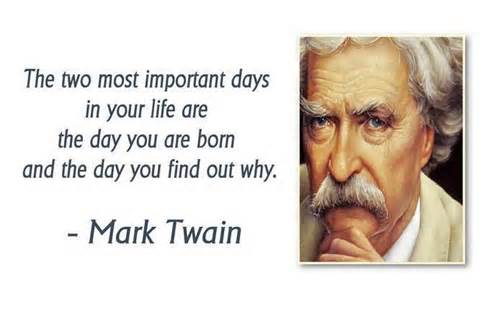
Here’s where all this silliness comes down to something very important for each one of us. You will remember the following quote attributed to Mark Twain from yesterday’s Catch: “The two most important days in your life are the day you are born and the day you find out why.” So today you’re going to help me celebrate the first birthday of my son by helping me come up with a list of trinkets we can turn into treasures, while we all can celebrate the second one, because that is the day you realize that you are loved, infinitely and completely, by God. For me that day repeats itself often, as I am prone to forget. And should you ever feel like a trinket, remember, to God you will always be His treasure. So in that last regard, Happy Second Birthday to us all!

Posted in Uncategorized | Tagged , | 18 Comments

What’s important

th-1Mark is Back! (Not Mark Twain … our Mark.) I’m so glad. He’s such an important person to us. He chose the right thing.

The issue is not who’s right or who’s wrong, it’s who’s committed to being a part of the body of Christ. The last thing God wants is for us all to agree. The first thing He wants is for us to love each other.

My goal is not to get you to agree with me or to be the last word on anything. I would like to be a word that leads you there, but the last word is and will always be from God, and you can only find that yourself. My goal is for you to know the truth, because the truth will set you free, and part of that freedom is the freedom of thought. You don’t have freedom of thought if I’m doing your thinking for you. You get to think what you want to think and say what you want to say as long as it’s covered in love. That’s what we are building here, a place where you can openly seek the truth and air all your questions along the way.

It has to be this way because the truth always challenges our way of seeing things. The truth will become yours when you find it, not when you agree with someone. So that means that on your way to the truth we may disagree. That’s alright. Be patient. Listen to what is being said. Look for the truth in it and confirm that in your heart.

Truth is not always a straight line. Jesus was constantly talking around things. He told parables and stories; He exaggerated things; He used every literary trick in the books including irony and sarcasm. Some of the things He said to the Pharisees can make your skin crawl. He did that because He loved them and it was the only way He could get through their blindness and their thick skin of self-righteousness. Jesus was not running a popularity club.

Jesus did not leave us a book of truths (i.e. this is the way you should think on everything). He was leading us to God. Try turning the words of Jesus into a manual. Try even outlining Him. You can’t do it. He did not come to bring us everything we need to know on every subject. He did not come to answer our questions; He came to question our answers, because our questions will lead us to God far quicker than our answers. Answers are only that: answers. Put them in a book and sell them. Teach them in a seminar and then get everyone to agree.

It’s much more important how we treat each other than what we think.

Posted in Uncategorized | Tagged | 12 Comments