In the company of women

th-1It is important to note that Jesus shared much of His life and ministry with women.

“After this, Jesus traveled about from one town and village to another, proclaiming the good news of the kingdom of God. The Twelve were with him, and also some women who had been cured of evil spirits and diseases: Mary (called Magdalene) from whom seven demons had come out; Joanna the wife of Chuza, the manager of Herod’s household; Susanna; and many others. These women were helping to support them out of their own means” (Luke 8:1-3).

Here you see Jesus in the company of women … women of means, no less, and there were many of them. They were a part of the company that travelled with Jesus at this time of His ministry, and they were women who had the influence and the financial wherewithal to help provide for the needs of Jesus and no doubt the others who were with Him. There is no mention of their husbands being present — it would appear that they were acting on their own — something that would create a problem for some conservative circles of Christ-followers today. Jesus appeared to make no attempt to qualify or restrict their participation in His work; they are simply a functioning part of the entourage.

I notice that this is mentioned here in my Bible, and I note the matter-of-factness of the account. It assumes their positions of influence and means. It assumes their importance to the discipleship team.

This is one of those things you don’t have to make a big commentary on except to notice it is there, because it was not meant to be taken as a teaching or a sermon point. It’s a big deal precisely because it was not considered unusual then. Nor should it be now.

We have many women who are contributors to the Catch and we encourage them to use their means and influence wherever they see a need as God directs. All of you need to know how important you are to Jesus.

“Some women were watching from a distance. Among them were Mary Magdalene, Mary the mother of James the younger and of Joseph, and Salome. In Galilee these women had followed him and cared for his needs. Many other women who had come up with him to Jerusalem were also there” (Mark 15:40-41).

This happened at the cross; they were with Him to the end, as they were with Him in the beginning — the beginning of life in the New Covenant — because they were the first to see and believe that Jesus had risen from the dead. They were the ones who went and told the others the amazing news.

Is it any wonder my wife is always the first of us to call on the Spirit!

Posted in Uncategorized | 2 Comments

‘It’s the hammer of justice’

thOkay guys, anyone have any trouble sleeping last night after your wife read yesterday’s Catch? I’ve been checking around to be sure all the hammers in our house are where they belong. The biblical story of Jael driving a tent peg through the skull of Sisera kind of gives new meaning to the song, “If I Had A Hammer” doesn’t it? If you think about it, the song does identify it as “the hammer of justice,” and what better way to hammer out justice than to hammer a tent peg through the temple of any guy who has ever treated a woman as anything less than himself? God knows we deserve it.

I think of how we used to make fun of my mother for being dumb and not being able to get the simplest jokes we cracked, and how she played into it because it was probably the only attention she was going to ever get, so she took it. I think of the times I’ve yucked it up with the guys, turning the women we know into emotional dufuses and somehow thinking that was okay. I think of all the times I’ve used sarcasm to “put a woman in her place” and laughed it off as a joke when in truth it really wasn’t. (Sarcasm rarely is.) I think of times when I’ve tried to gain a sense of power off the weakness of women instead of holding them in high esteem, or considering them as scripture would have it, as more important than myself, and I begin to think I deserve that tent peg.

We do this in our culture; we do this in our churches. We have subtle ways in which we create and maintain injustice in our own homes without even working at it.

Well, it’s time we started working at something else. It’s time we started working at value, worth, honor and dignity.

Hey, don’t just make her your Valentine, make her your equal. Don’t just give her flowers; giver her respect. Don’t just give her a box of chocolates; give her your attention. And not just on February 14; make it every day.

Hammer out danger if you don’t. Hammer out a warning unless you do. Hammer out love between brothers and sisters everywhere. God loves it. Justice requires it.

Posted in Uncategorized | 2 Comments

Never a dull moment

by Marti Fischer

th-1Dorothy Sayers is one of my favorite writers who never found Christianity or life itself, dull. She once wrote, “Perhaps it is no wonder that the women were first at the cradle and last at the cross. They had never known a man like this Man — there never has been such another.”

This Man, we women know, loves us, respects us, and considers each of us His ongoing creation. He did not create all of us women to do the same thing. Rather, He created each one of us to do a special thing in the world, and then set us to toil in whatever each of us does, leaving us to discover, in our task, what it is that distinguishes us.

Whatever “it” is, we know it is unmistakable, for it has been willed and empowered by the Man himself for He is “able to do immeasurably more than all we ask or imagine, according to His power that is at work within us” (Ephesians 3:20). Whatever it is, let it be illuminated by the power of our specific calling.

To demonstrate my point, I want to tell about a woman and the special thing she discovered that she was created to do. To tell my story, we need to go back a century or so after the Hebrews entered Canaan (the Promised Land). There is a commander of King Jabin’s Canaanite army, Sisera.  Sisera with his troops is spending his days — 20 years altogether — oppressing the Israelites.

There also is a wise and courageous ruler or Judge of the Israelites named Deborah.  The only woman among the twelve judges, Deborah followed God faithfully, acting with integrity in her duties. Her boldness came from relying on God, not herself. In a male dominated culture, Deborah did not let her power go to her head, but exercised authority as God guided her.

But my story is not about Deborah.

Deborah prevailed upon Barak, her military general and a heroic leader, to unite the tribes of Israel for greater strength, and because God had gone before him, he defeated Sisera’s Canaanite army at Mount Tabor.

But my story is not about Barak. My story is about Jael.

“The troops of Sisera fell by the sword and not a man was left” — except Sisera, who deserted his army and ran to the camp of Heber the Kenite, near Kedesh. Heber and King Jabin were allies. As Sisera staggered in, Heber’s wife, Jael, welcomed him into her tent (Judges 4:16-17).

The exhausted Sisera asked for water, but instead, Jael gave him curdled milk, a drink that would make him drowsy, and hides him under a blanket where the thoroughly frightened and exhausted man drops off to sleep — a sleep from which he never awakens.

The writer tells what happens next with elaborate detail: Jael takes a tent peg and the mallet with which the pegs were driven into the ground and hammers the stake through Sisera’s head!  In a while, Barak arrives. Jael takes him into the tent and shows him the gory sight. In silence, Barak turns and walks away. (The honor of the victory is not his to claim for as Deborah previously predicted, the Lord delivered Sisera into a woman’s hands (Judges 4:9).

Deborah’s poetic version of Jael’s deed follows:

Her hand reached for the tent peg,
    her right hand for the workman’s hammer.
She struck Sisera, she crushed his head,
    she shattered and pierced his temple. (Judges 5:26)

“Most blessed of women be Jael,” Deborah and Barak sang of her, and what did Jael do to merit such praise? Simple. She did what lay before her — the thing she was created to do.

Jael’s hammer was a hammer of justice. From that day on, the hand of the Israelites grew stronger and stronger against Jabin, the Canaanite king, until they destroyed him. Her heroic act was the beginning of the end of Canaanite control. Thus Israel, the repository of the “seed” through which Christ was born, was spared to that end, that she might play her part in bringing salvation to the world. “And I will put enmity between you and the woman, and between your seed and hers; he will crush your head, and you will strike his heel” (Genesis 3:15).

My point in telling this story is this: We never know what heroism lies in quiet obedience to God within our ordinary lives, and there’s no biblical reason why you, in your obedience, should not play an extraordinary role in the unfolding drama of world redemption.

We women will never know a man like this Man, Jesus Christ, because there never has been nor ever will be such another. He created each one of us to do a special thing in the world. He has set us to toil. Our task is to discover what it is that distinguishes each of us. Whatever it is is unmistakable, for it has been willed and created by God. Whatever it is — Go! — with all the force of the Spirit (and all your anxiety) for the needs of the world are immense. Do not copy others but trust that God is “able to do immeasurably more than all we ask or imagine, according to his power that is at work within us…”  (Ephesians 3:20)

Like so many women including Dorothy Sayers, you will never find Christianity or life itself dull again.

Posted in Uncategorized | 4 Comments

Seeing beauty

 Jump in the mess of human lives undressedth
 And sin unconfessed… and see beauty.
 Look at the sea of misfits and misery
 And cry ’til you bleed… and see beauty.
 That’s what God does!
 That’s what God does!
 That’s what God does, why can’t we?
–  Skypark

God is crazy about you. He’s all over you like a glove. God waits for you, hanging on your every word. He loves to hear you call to Him. He has been relentlessly pursuing you since before you were born. He sacrificed His Son to remove the barriers to His love for you, and He has plans for you that go way beyond anything you can imagine. How do I know all this? I’ve been reading about it in the Bible for most of my life, and I know it in my heart, and I’m telling you about it because I need to hear it again myself.

How tragic to be measuring and comparing ourselves — trying to qualify for a love we’re already qualified for just by being alive.

Appropriating God’s unconditional love is not as given as it might seem. Jesus said we were to love our neighbor as we love ourselves, but what if I have a problem loving myself? Then the reverse is most likely true; I won’t love anyone else either.

Here’s how to end all this nonsense. Accept God’s love for you as totally undeserved. You’re just as much a scoundrel as the next guy, but here’s the amazing thing: God’s crazy about you. He looks at you and sees beauty. Don’t ask why or how; just believe it. Believe it and you’ll start to see people as beautiful, too.

Since when do you love people just because they exist? Since you found out that’s what God does! So when it comes to loving yourself, do what God does: Look at yourself and see something beautiful. Soon you’ll see everyone else that way, too.

Waste all the best on the most dishonored guest
When she’s unimpressed… and see beauty.
Give ’til you’re gone to the least deserving one
And call him your son… and see beauty.
 
That’s what God does!
That’s what God does, why can’t we?

Posted in Uncategorized | 2 Comments

In the dog house

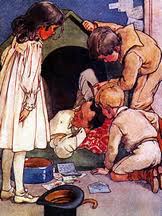
imgresIn Marti’s favorite children’s story, Peter Pan (a children’s story albeit tinged with a good amount of adult psychology), George Darling, father of the three children who have been whisked away to Neverland, condemns himself to taking up residence in the kennel (the dog house), until the children come back. This is his self-inflicted punishment for having tied up the dog, Nana, while he and his wife were attending a party. His belief is that Nana would have prevented the children’s departure had she been allowed to babysit them as the children had requested.

J.M. Barrie, author of the original story describes Mr. Darling as “a simple man; indeed he might have passed for a boy again if he had been able to take his baldness off; but he had also a noble sense of justice and a lion’s courage to do what seemed right to him.”

What seems right to him is to stay in the dog house until the children return. I am not certain whether this is the origin of the phrase “in the dog house” for a man who is not in good standing with his wife, but it sure does create an indelible picture of living out one’s sentence in a manner certain to impress.

Being a man who does things to excess “otherwise he soon gave up doing it,” he sticks to his promise, even to the extent of traveling to work and home again by cab so he can remain in the kennel.

“Soon the inward meaning of [what he was doing] leaked out, and the great heart of the public was touched.  Crowds followed the cab, cheering it lustily; charming girls scaled it to get his autograph; interviews appeared in the better class of papers, and society invited him to dinner and added, “Do come in the kennel.”

Though Mr. Darling’s sense of justice and courage to do what’s right could be applied to more important things in a less dramatic way, we can nevertheless admire his desire to take responsibility for his own actions and see that justice is done. I must say that more often than not, my tendency when accused is to defend myself, and that defense can take up so much of my attention that I fail to see where the wrong is in me. Justice is always more easily applied to others than it is to ourselves.

Maybe spending some time in the dog house isn’t such a bad idea. The only person you can really change is yourself, and that not without the Holy Spirit. Just don’t show up in the kennel; I’m not sure any of us needs that kind of attention!

Posted in Uncategorized | 3 Comments

What the world needs now is another lemonade stand

thMarti weighs in on justice/injustice…

Do we really have a good excuse for just staying on the sidelines and watching? Do we really need to fear the approaching emotional manipulation with its appeal for what we should be doing? But Marti, how do I get involved with making right what has gone so horribly wrong, and who do I pull in to help fulfill the need?

As to that first question, we no longer have an excuse to be bystanders. If we want to be where God is, we must feed the poor, lift the oppressed, and care deeply.

But how?

Even if we wrench ourselves awake from the dreamy indifference with which the world’s poor have forever been treated, we become aware that in ordinary times, we give when it’s easy — a gesture…a reflex…a salve to the conscience. The entreaties come on late-night TV or in the mail from well-meaning but long-discarded celebrities who cuddle with large-eyed children and appeal to our pity and guilt. Maybe we send off a check and hope it will help someone somewhere stay alive for another day. That is not the model for us current crusaders or the message for these extraordinary times.

Like children with their neighborhood lemonade stand, every enterprise has to start somewhere. For every lemonade stand there is a beginning to inform, invite and involve in the practice of justice, to teach the inequities that every disaster exposes, and to help people understand that in the poorest of countries, everyday is a deadly tsunami.

Embrace everyone who tries, including the endearing person who unscrupulously tries to exploit. Invite people to think globally, but to act carefully, always demanding efficiency. For every fact that you know about injustice, find one action you can do about it. Prove what works. Then use whatever leverage you have to get it done.

If you find yourself tiptoeing around prejudice or condemnation, you know that you’re in the wrong place. Move on as the Lord directs.

No matter what you do, it will never be enough. Yet this is not an excuse for helplessness. Invite everyone to your lemonade stand in a way that makes people think they are missing something if they hold back. Be genuine. Gain nothing personally. Open yourself up to criticism because you are willing to work with anyone to find help for whatever has taken your heart — and insist on making right what has gone horribly wrong.

Finally, do not operate out of pity, but operate out of passion. Pity sees suffering and wants to ease the pain; passion sees injustice and wants to solve the problem. Pity implores the powerful to pay attention; passion warns them about what will happen if they don’t. The risk of pity is that it kills with kindness; the promise of passion is that it builds on the hope that the poor are fully capable of helping themselves if given the chance. The world’s poor do not need sympathy, they need people to be informed, invited and involved in making a difference. We are not talking about size or scope, but about getting to work to make right what God has placed on your heart.

You see, Africa makes a fool of our idea of justice. It makes a farce of our idea of equality. It mocks our pieties. It doubts our concern. It questions our commitment. Because there is no way we can look at what’s happening in Africa, and if we’re honest, conclude that it would ever be allowed to happen anywhere else.

Bono, Congressional record – Senate, volume 152, Pt. 17 November 14, 2006.

Posted in Uncategorized | 7 Comments

What kind of justice?

imgresI’ve noticed in this discussion of justice that there are (at least) two uses of the term. One has to do primarily with law, the other with equal rights. One is our responsibility; the other is not.

Justice as punishment, retribution for wrong doing or settling the score is not our responsibility apart from our civil duty as part of a representative form of government. This one is handled socially in a court of law and in the end by the judgment of God. This part of justice is best left to God and the state. As the scriptures remind us, “Never take your own revenge, beloved, but leave room for the wrath of God, for it is written, ‘Vengeance is Mine, I will repay,’ says the Lord” (Romans 12:19).

However, justice in terms of fairness and equality is our responsibility and it comes down to how we deal with our fellow human beings. It is spelled out in terms of worth and dignity, and evidenced by how we treat the people around us.

God is always on the side of the poor, the innocent and the foreigner. When He handed down laws to the children of Israel there were provisions made for these people, because God knew that they would get trampled by society otherwise. You and I as followers of Christ need to pick up this priority and see that the poor, the innocent and the foreigners within our sphere of influence get valued and lifted up. It is our charge to go out of our way to do this because no one else will. And it’s not just about food, clothing and handing out a few dollars here and there. It’s about giving people back their worth and dignity.

Marti’s work at the Isaiah House is all about dignity, not sheltering and feeding the homeless. That’s why she prefers to call them “women without homes” instead of “the homeless.” “The homeless” is a category; “women without homes” are individuals, each with a name and a story. All of our special programs are specifically designed to honor those names and tell those stories. The soup kitchen aspect of Isaiah House is a given. These women will get fed, clothed and a roof over their heads. Marti has made it her goal to see that they get honored. That is justice being done.

Posted in Uncategorized | 1 Comment

Justice and mercy

thIs there anybody you’d rather not see in heaven? What if God chooses to extend mercy to that person? Would you go away and pout like Jonah?

When Jonah finally got his directions straight and went to preach to Nineveh, he was distraught because they heeded his warnings about God’s coming judgment, and God showed them mercy by reneging on his intention to destroy the city. Turns out this is exactly what Jonah was afraid would happen, and that’s why he didn’t want to go there in the first place. In this case, Jonah was all over justice being done, but the city got mercy instead.

Justice and mercy are two sides of God that come together in Christ. The cross of Christ is both the justice of God and the mercy of God. It is the justice of God in that it is the payment for sin. If you’ve ever wished an evil act would get its proper due, that wish was fulfilled in the cross. The cross catches the human race in the act of sin and disobedience. It’s the bad guys getting what they deserve. But it is also the mercy of God in that Christ is on it and not you or me. Christ is on it in our place, and that’s where this gets personal. Everybody gets it, even the bad guys I wish God’s judgment on. If I want mercy for myself, I have to allow it for everyone else with no partiality. This is the lesson Jonah had to learn and I’m not so sure he learned it. Nineveh repented of it’s evil ways, but there is no indication that Jonah repented of his judgment without mercy.

Mercy is such good news. It is good news for everyone, but especially for me, because I know my sin better than anyone, but it must be given to be received. You can’t receive mercy and still make everyone around you pay. If you get mercy, they get it — even the worst of them — the ones you hope you don’t see in heaven.

We may need to make some adjustments in our thinking.

Posted in Uncategorized | 11 Comments

Caring about justice

th-3The righteous care about justice for the poor, but the wicked have no such concern. (Proverbs 29:7)

A quick perusal of the use of the word “justice” in the Bible reveals something that is key to the nature of God. “For I, the Lord, love justice; I hate robbery and wrongdoing” (Isaiah 61:8). Numerous times He is called a God of justice. Now about half the time this is tied to championing what is right and the judgment of wrongdoing, but half the time it is tied to the innocent, the poor and to foreigners — in other words, people who are not likely to receive fair treatment. “Do not pervert justice or show partiality” (Deuteronomy 16:19).

It is a truth that those who question the existence of a loving God based on the poverty and oppression that is in the world (how could He allow such a thing?) would find, if they took to the word of God, a God who is just as concerned, if not, more concerned than they are about treating everyone fairly. And if God is concerned about this, how can we not be? Or as my friend Tony Campolo says, “Our hearts should be broken by the things that break the heart of God.” It definitely breaks the heart of God when the poor, the innocent and the foreigner are treated as less that those who are more privileged, or when someone is deprived of food, clothing and shelter for the crime of being born where they were born.

Or as Marti defines justice: “Is it just if where you live determines whether you live?” Who can control where they live — what family they were born into, what privileges they have or don’t have? This is an injustice because this is not a just world. We need to care about this and do what we can to right it through our support of those who are seeking to change these situations by providing food, shelter, small business loans and jobs that would not exist otherwise.

What does this mean for you and me today?

It means to seek, however we are able, to support those whose lives are being threatened by where they live, to see everyone we meet as equally deserving of the rights and privileges we would afford ourselves, and to treat every human being, regardless of race, religion or citizenship, with the dignity that behooves a creation of God in the image of God.

That would be good for starters.

Posted in Uncategorized | 10 Comments

More important matters

imgres“Woe to you, teachers of the law and Pharisees, you hypocrites! You give a tenth of your spices — mint, dill and cumin. But you have neglected the more important matters of the law — justice, mercy and faithfulness.” (Matthew 23:23)

How we love to control what we can control and let go by what we can’t. How well I understand this. This is the diversion of religion, and when Christianity becomes just a religion, we get all taken up with things like going to church, reading our Bibles and praying while missing the bigger issues of the heart — things that color all that we do and say. Jesus mentions three of those things here: justice, mercy and faith.

The first one, justice, is sorely missing in conservative Christianity today and has been for some time. I admittedly know little about it and I have been around Christian ministry all my life.

Years ago, in the civil rights movement of the 1960s, the church let the world take up the banner of justice and we haven’t done much about it since. Yet Jesus mentions it as one of three important things for us not to miss. How many sermons besides those of Martin Luther King, Jr., admonished us as followers of Christ to treat everyone adequately, fairly, and with full appreciation — and that’s just one aspect of justice. There are many more.

I think we get confused over this sometimes because justice is often paired with its social counterpart to create social justice — something that has more to do with the laws of the land than with individual responsibility. That may be obliquely related to what Jesus was talking about here, but I think He meant something more attached to the heart, and how each one of us thinks about and treats other people.

We are going to look more into this in the coming days, but I must say that I am not as far along on this journey as many of you probably are, so bear with me. I have much to learn.

How can any follower of Jesus bypass what He has so clearly marked out as being an important matter? So please, teach me about justice. Write to me with some illustrations of what you have experienced as acts of justice or lack of it. Let’s do this together. Marti believes that justice is going to play a big role in the next spiritual revolution and I, for one, don’t want to miss it this time.

Posted in Uncategorized | 8 Comments