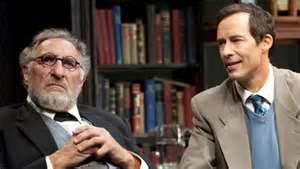
Frued’s last session (and our next slumber party)

Freud & LewisFreud’s Last Session centers on legendary psychoanalyst Dr. Sigmund Freud, who invites a young, little-known professor, C.S. Lewis, to his home in London. Lewis, expecting to be called on the carpet for satirizing Freud in a recent book, soon realizes Freud has a much more significant agenda. On the day England enters World War II, Freud and Lewis clash on the existence of God, love, sex and the meaning of life – only two weeks before Freud chooses to take his own.

“A juicy intellectual debate,” says one review. This is the description of the play we will attend tonight accompanied by our son and new daughter.

Now does that sound like fun or what? Certainly sounds like it will be good for much conversation before and after. Well, we’re going to get that conversation because Christopher and Elizabeth have Mom and Dad going to the theater tonight to see this live performance followed by what Beth calls a slumber party at their tiny one bedroom apartment in Seal Beach. (I mentioned that I hadn’t been to a slumber party in 50 years and could we have a pillow fight. Beth texted back “B.Y.O.P. — Bring Your Own Pillow.”)

Marti is a little self-conscious about the overnight. She is a high maintenance woman requiring hours of mirror time prior to bed and meeting anyone in the morning. That seems problematic in close quarters, but hey, closeness is next to godliness, isn’t it? Or something like that. I see some future Catches on the horizon.

Here’s what I’m looking forward to: we’re going to be wrenched out of the pressures of everyday living to be with people we love and think and talk about why we live to think and talk. (Well, I don’t want to insist we do that but it has all the earmarks of that kind of evening, doesn’t it?) Isn’t it interesting that it takes art to do this? Art, drama, theater, film, story…  Where would our lives be without these moments to reflect? Where is the life we have lost in living? It’s kind of a shame that it takes something like this to find it again.

I must say I’m thankful to those who put this drama together and made an event of it so that we have to stop what we’re doing and meet it. I’m thankful that they made it good enough to draw attention to it. (Good art makes it official.) I’m thankful to Mr. Freud and Mr. Lewis for giving us something to think and talk about. I’m thankful to my son and new daughter for the idea, and for putting this whole thing together. I’m thankful to you all for a forum in which to write about it. And finally, I’m thankful to God for putting us all on this spinning planet and not telling us everything.


Posted in Uncategorized | 2 Comments

Love, Mom

Love, MomEvery once in a while I receive an unintentional copy of a forwarded Catch along with a note to the intended recipient. I find these to be the truest endorsements of all because no one is expecting the writer to be looking on. I mean, it could be something like “Can you believe this jerk said that?” Yet so far, they have all been positive — people forwarding a Catch because they feel the content will connect in a particular way with someone they love. Perhaps help them confirm some issue or perspective they’ve been trying to convey.

Like yesterday when I got the following in regards to the last Catch about God wanting to join us for coffee. “Alex, please read this. Love, Mom.”

Now Alex… listen to your mom. She doesn’t know everything but she does know you, maybe even better than you know yourself. Obviously something I wrote yesterday is something you’re going to like, or something you need, or she wouldn’t have sent it to you.

I don’t know how old you are, Alex, but who knows? You might be old enough that your mom is starting to make sense again, you know, like she used to? Remember when you used to think your mom and dad were the smartest people on the planet? Well, okay, maybe not the smartest, but pretty darn cool, anyway.

If anything, Alex, receive it as love… pure love. She wants to share with you something that is important to her, and I don’t think you want to miss that.

I don’t have my mom here anymore, but when she was here, she used to read me stuff all the time — stuff that meant a lot to her. She had a stack of books she would read from every morning, and if I was anywhere around, she would make me sit down and listen to her favorite parts. Sometimes it would make her cry. Just because it touched her deeply. It used to make me squirm. I probably thought at the time that she was trying to force something on me. I see now that it was all because she loved me. She was giving me something of great value to her. So for that reason alone, I would pay attention. I’m glad I did.

Oh, and by the way… she doesn’t know that I know she forwarded something on to you. Let’s keep it that way. You’re a lucky man, Alex. You know that, don’t you?

Posted in Uncategorized | 5 Comments

Join me for coffee…

coffee cupJob argued with God. Moses bargained with Him. Jacob wrestled with Him. Nehemiah changed His mind. What do these amazing stories tell us about God if it isn’t that He wants a relationship with us probably more than we want one with Him. What does it tell us about God if He is willing to be persuaded, cajoled, bargained with and wrestled? It tells us He created us like Him so we could participate in a relationship with Him that means something in terms of integrity. It’s no small thing for God to be swayed by a puny human being, but such is the wonder of His will.

The Psalmist has declared a similar wonder when he wrote, “When I look at the night sky and see the work of your fingers — the moon and the stars you have set in place — what are mortals that you should think of us? For you made us only a little lower than the angels, and you crowned us with glory and honor. You put us in charge of everything you made, giving us authority over all things—the sheep and the cattle and all the wild animals, the birds in the sky, the fish in the sea, and everything that swims the ocean currents” (Psalms 8:3-8 NLT).

In other words:  What’s the big deal here? We’re the big deal. Does this bring us glory? Yes, but that only brings Him more. That He would create us with this much power and authority says a lot about our Creator and what He created us for. He created us with intelligence and emotions. He created us like Him so He could relate to us and we could relate to Him. And He gave us the right to refuse Him, accept Him, argue with Him, badger Him — even tell Him to get lost if that’s what we want to do. Think about that. Even unbelief has integrity. What kind of God would create a being that might not even believe in Him? A God who wants us to join Him for coffee anyway.

Posted in Uncategorized | 9 Comments

Living in the impossible

thJesus looked at them and said, “With man this is impossible, but with God all things are possible.” (Matthew 19:26)

In a comment on Friday’s Catch, one of our Catch members used the phrase “living in the impossible,” and I immediately lit on that as something I could use in my life as a daily challenge. Living by faith would of necessity put me in the realm of the impossible or else faith would not be necessary.

This does not mean that we are regularly healing the sick and raising the dead; it just means we are doing what for us would be impossible without the enabling of the Holy Spirit. It could be something as simple as balancing a checkbook if that is something that is your responsibility that seems beyond you.

To tell you the truth, a good deal of what is required of me these days seems beyond me. That is not a bad thing; it just puts me in the realm of the impossible most of the time, which means I require a daily, moment-by-moment faith in order to carry on. If this isn’t also true for you, you might want to consider whether you might have arranged your life is such a way as to not need faith to live. Please don’t think that by saying this, I am necessarily doing it. I’m simply realizing what a life of faith looks like. It means different things to different people, yet it remains in this way the same for all of us — that God is asking us to do what is beyond the realm of human possibility for us, but what is easy for Him.

So what is that for you? Being a good husband, father, wife or mother… being a good employee… connecting with the needs of those around you… getting outside yourself to see and feel with others… being obedient to God… pulling your own weight… making right what you have done wrong…? The list could go on. Whatever for you is impossible, as long as it is something that needs to be done, it is now within the realm of possibility for you because “with God, all things are possible.”

Posted in Uncategorized | 8 Comments

God so loved the world

cathedral choirFor God so loved the world, that he gave his only begotten Son, that whosoever believeth in him should not perish, but have everlasting life. For God sent not his Son into the world to condemn the world; but that the world through him might be saved. (John 3:16-17)

My father was the choir director at the church I grew up in and there was a choral arrangement of John 3:16 & 17 that the choir often sang. It’s a beautiful setting for this most famous of evangelical verses that starts softly and crescendos to it highest point around the lyric “have ever lasting life,” but then it softens back down to where it ends with three “God so loved the world”s – the last one, almost inaudible. It’s an important rendition that leaves you not with everlasting life, but with God’s love – the motivation for what He did.

To end the verse where it started was brilliant, but even then, I didn’t get it. We were too busy thinking about everlasting life – how you got it, who got it and who didn’t – that the part about God’s love was wasted on us. John 3:16 was always thought of as the key to getting into heaven, when all along, it was really a love song. It’s a love song that tells us what God’s love did. God’s love brought Jesus to us. God’s love connected with us. It climbed inside our skin, walked in our shoes, went to our parties, weddings and funerals, slept under our stars, suffered our minor irritations and our big calamities, was misunderstood, misjudged, misinterpreted and mistaken, and ultimately suffered our sufferings and died our death. God’s love did a lot. God’s love gave everything it had that we might have everything it gave.

So now, as a follower and interpreter of God’s love to others, what will you do? What will you give? What will you sacrifice? These are big questions for me today. I hope you will pick them up too and do something.

God so loved the world…
God so loved the world.
 
For a beautiful rendering of this choral work by John Steiner, click on the picture above of London’s Saint Paul’s Cathedral Choir.

Posted in Uncategorized | 7 Comments

Human reclamation project

reclamation projectA revolution usually starts with the kernel of an idea. In yesterday’s Catch I stripped the gospel down to its core so we could remember what we are starting with. I left out lots of things that are important but not essential. “God so loved the world that He gave His only begotten son, that whosoever believeth in Him shall not perish but have everlasting life” (John 3:16). (Sorry about the King James English, but that’s the way I learned it.)

Three things stand out here. Forgiveness of sin, eternal life and the fact that what God did was all motivated by love. Love was the cause.

In the very beginning of the human race, sin entered the picture and the penalty for sin is death. The fact that we live 10 years, 25 years, 50 years or a hundred years is irrelevant; we all die. God could have ended it as soon as Adam and Eve disobeyed Him, but His love created a way to redeem the race through His son paying the penalty in our place thus ensuring a life forever with Him – what He was after in the first place. That life is the whole point. Getting people reconnected to God so they can live that life is the essence of the gospel. The fact that we can begin experiencing that life in this one is important, but it’s not the whole point. The fact that we, as the result of a relative amount of affluence, can make this life a pretty good one is probably more a hindrance than help. While we are doing that, there are a vast number of people on the planet for whom death is a welcome relief. Jesus said the poor and the hungry were more blessed than the rich and full because they see this and grab onto the hope of a better life in eternity. From an eternal perspective, who’s better off now, the rich or the poor? How do you think Christ would answer that question?

Does this mean we don’t care about the current state of affairs for everyone? Absolutely not. We love as God loves and Jesus did much to improve the physical condition of everyone He touched. He fed them when they were hungry, He healed them when they were sick, and even raised some from the dead, but this was not His primary purpose. Many of them got sick again, and most certainly, they all died. His primary purpose was to die in our place and put us in touch with His Father for the purpose of reclaiming the life we were meant to live with Him, both now and forever. When now fails, forever brightens.

Let me leave you with this thought, because I have watched Marti exhibit something through her work with the Isaiah House that I didn’t understand at first, but I am getting it now. She always said her real goal, more than to improve the lot of the homeless, was to put the volunteers who have wealth and homes in touch with their own poverty. I think I’m beginning to understand why.

Posted in Uncategorized | 1 Comment

Starting a revolution

thinkingDo you know Jesus? He died on a cross to forgive every bad thing you’ve done (or ever will do) so that you can know God and live with Him forever in heaven.

Is there anything more to this? Well, yes, there are a few other details, but this is all you need to know. There is more to the story that merely confirms that this is true; there is more to keep theologians busy for the rest of their lives, but this is all you really need to know. Jesus died on a cross to forgive every bad thing you’ve done (or ever will do) so that you can know God and live with Him forever in heaven.

Is God going to fix everything?
Are all your problems going to go away?
Will you have a better life?
Will all your dreams come true?
Will you get rich?
Will you be healthy?
Will nothing bad ever happen to you?

No, not necessarily. Nothing beyond this is a guarantee. But this is definitely a guarantee: Jesus died on a cross to forgive every bad thing you’ve done (or ever will do) so that you can know God and live with Him forever in heaven.

Lots of people try to complicate this and there are disagreements among those who believe it about how to carry on (this is unfortunate), but this is the essence of it. It doesn’t really matter what else you believe, as long as you believe this. This is really all you need to know, and all you need to tell the world about (because once you know it, you’re going to want to tell everybody). Jesus died on a cross to forgive every bad thing you’ve done (or ever will do) so that you can know God and live with Him forever in heaven.

Honestly, it’s enough to start a revolution.

Posted in Uncategorized | 8 Comments

No longer dodging Jesus

larry normanI understand why Marti is asking that I stop avoiding conflict. How can I sing a new song of deliverance to those who have no hope if, at the same time, I insist on remaining comfortable among those who do?
 
She reminded me of my early Christian days where I was honored to be part of a movement built around songs of salvation. We were personally involved in ministries of mercy and issues of compassion and significance. We took on the voice of the prophets, penetrating into those aspects of our culture where the truth of God had a sure and true word for us. We articulated the vision of a radical kind of Christian discipleship. Our voices shined the light of God on the darkness of racism and injustice, and we awoke others to the realities of poverty and corruption.
 
Many miracles occurred during that season. Yet sadly, few churches were ready for this new influx of radicals, so the movement thrived without many churches participating or offering invitations of welcome. There was more freedom and a far more receptive audience outside.
 
Why were so many churches not ready? In my opinion, they were much too comfortable with the status quo. One of my earliest songs, “The Cold Cathedral” cried for spiritual reality in the midst of religious deadness, sameness, and a comfort-seeking isolation from the real needs of people – inside and outside the church.
 
While no longer cold, I fear many of our churches today are in similar places of complacency for other reasons. Instead of cold cathedrals, we might refer to many churches today as “cool” cathedrals – “cool,” as in stylish/fashionable/in vogue. They are so ‘cool’ to the needs of their people that relevancy could in some instances be considered the new god. Today, we seem to again reflect the concerns of the status quo, and the easy acceptance of a world where how we feel is the great crisis of our time. We produce a massive consumer niche of ready to buy, wear, and applaud whatever fits in our pre-described mold of entertainment-oriented discipleship. We dress the way we want to dress, sing songs we want to sing, and hear messages we want to hear. Everything is catered to us. It’s also about a short list of predetermined social issues and not the widespread prophetic agenda of justice and compassion. It’s the church where we want more of Jesus and less for the unjust, hungry, oppressed and displaced. After all, why care as Jesus did for the sick or feed the hungry or release the captives, or treat individuals as an ongoing creation of God when He is coming back tomorrow?
 
It is time to stop avoiding conflict – stop dodging Jesus – for our more comfortable, more cool Christianity. God wants to drive us right into conflict so He can demonstrate His love and mercy through us where it is most clearly needed.
 
It is time we sang a new song – a song of deliverance and hope without judgment, as we apply the Gospel in a way that embodies Christ’s heart for the hurting, the weak, and the outcast. It is a new song of reconciliation that causes those with no hope to hear, to run to Him and not away from Him, because acts of love are occurring and not just words.
 
We have a new song made even surer than the songs of those who mounted the countercultural Jesus movement of the early 70‘s. It is time for isolation and protection to cease. It is time to be the hands, feet and heart of the gospel. Time to venture out of our comfortable places and meet Jesus where He is.
 
And where is He? He is with the vulnerable and the poor. God is in the debris of wasted opportunity and lives. He is in the place where our deep gladness and the world’s deep hunger meet. God is with us if we are with them.

Posted in Uncategorized | 8 Comments

Good conflict

good conflictLots of good comments on conflict. Many of them centered on what I would call conflict that doesn’t go anywhere. One reader called it “good conflict” and “bad conflict.” My make-up would tell me all conflict is bad (or maybe “difficult” would be a better word), but it’s what we do with it that makes it redemptive or not. The key to this is Marti’s second point: Connecting. We don’t fight to win; we don’t fight to bash; we fight to connect. Conflict that produces fruit is conflict that results in connecting, reconciliation (a new relationship) and change to both parties. Conflict that goes nowhere is just a boxing match with both parties returning to their respective corners to lick their wounds, having experienced no connection and no change (similar to what we are experiencing in American politics right now.)

In facing His conflict with us over sin, did God connect? Did He change? Did He ever. God’s main desire in making us was to connect with us. Literally to become one with us. The metaphor is marriage; the goal is intimacy, i.e. total and complete oneness. “…that all of them may be one, Father, just as you are in me and I am in you. May they also be in us so that the world may believe that you have sent me” (John 17:21). That is connecting on the grandest scale. (On a day when Marti and I celebrate 38 years of oneness, it’s a fitting reference.) And to do that, God had to humble Himself, take on the form of a servant and become like us in the flesh. He learned obedience through the things that He suffered to the extent that He actually became sin for us. He, who knew no sin, became sin, that He might declare us righteous through His own death and resurrection. It’s definitely a challenge to our theology to think of a God who changes, but the scriptures present it this way. This all-knowing God still learned things He could not have learned without becoming one of us. Knowledge is one thing; experience is another, and what God “learned” through experience is the same as what we learn when we face into conflict and become vulnerable to change that we might connect with others.

How do you befriend a gay person while thinking you are completely other than them (or the other way around, for that matter)? You can’t. How do you connect with the poor or the homeless without becoming like them – discovering your own poverty and homelessness? “Foxes have holes and birds of the air have nests, but the Son of Man has no place to lay his head” (Matthew 8:20). How do you reconcile yourself with someone without connecting to what is similar in yourself? How do you connect with a sinner without knowing your own sin? You have to connect. As we were reminded in the last paragraph, Jesus connected with us all the way to becoming sin for us. Unbelievable. How far are you willing to go with this? As far as Jesus went?

As a kid in church prompted to memorize scripture verses for rewards, we used to all love John 11:35 because it was the shortest verse in the Bible: “Jesus wept.” Talk about connection…

Conflict, connection, reconciliation, change. This is how it worked for God and no reason not to think it would be any different for us. How do you love without this? How do you function as a follower of Christ in the marketplace without doing this? I don’t think you can.

Posted in Uncategorized | 4 Comments

Facing conflict

facing conflictIf you’re just picking this up after the holiday, Marti was still holed up in our tiny bathroom with the little electric space heater because our furnace was temporarily disabled, when she decided to allow me into the inner sanctum as long as I would allow her to hold court on an idea that has been taking shape in her thinking for some time. So I removed a few layers of clothing (my way of dealing with the cold), my stupid wooly hat with the earflaps down, and joined her. What she uncovered with me is a way of looking at things that forced me to pry open some long-standing evangelical cans of worms, and look at things in a new light. I must admit, I am still somewhat skeptical, though I see much sense in her ideas, and feel I must take them seriously, in case my hesitation is merely my religious in-breeding raising its ugly head. There is also the small matter that Marti is not stupid, has her own spiritual gifts and understandings, and has a history of being right, oh gosh, most of the time, I would have to say.


So here is her thinking in a nutshell, and realize this is my current understanding of her thinking, which is undoubtedly somewhat askew, but something I want to attempt, as I know that one of the quickest ways for me to get to the bottom of something new is to write about it and hear what someone else thinks about it. (That’s where you come in.)

It all centers on conflict. Conflict is necessary for real connection to take place. You can’t connect with anyone without conflict. Take the gospel, for instance. Sin obviously has created a conflict between God and us. God has solved that by putting our sin on His son on the cross. That works fine outside of time and space where these transactions have once-and-for-all consequences. However, inside of time and space where we live, sin is still a factor in our relationship with God, so therefore, conflict is too. And yet God connects with us anyway. He has found a way to connect with us – present tense – in our sin, which He paid for, and even more than this, He has reconciled us to Himself. So with Christ, the end result of facing into conflict is connection resulting in reconciliation. Not too bad a result for facing into something like conflict that most of us try to run away from. And facing conflict is not just a path to some deeper experience; it is a requirement for right relationships. We can’t experience reconciliation without embracing conflict just as we cannot experience forgiveness without embracing our sin.

There are only two choices when it comes to conflict: face into it or face away. One leads to reconciliation and hope, the other leads to isolation and further conflict. Think about America’s current political landscape for a good example of conflict without reconciliation. You have to go back to Civil War days to find the country more divided with no one willing to even try and connect with the other side.

But herein also lies the hope, because those willing to connect in spite of conflict will find an empowerment that comes from facing their own fears in the fears of others, seeing their poverty in the needs of others, and experiencing their judgment in the judgment of others toward them. This is what makes reconciliation possible, because in connecting, we are changed; we are simply not the same person we were before.

Every day is full of choices to remain comfortable – to stay within everything you know and believe, or face into the conflict of another outside yourself, and become vulnerable to the reconciliation process that comes through meeting Christ over and over again.

Nobody likes conflict (except perhaps my wife who seems to relish it most of the time). Most of us avoid it at all costs usually steering clear of anything that we know might cause it, but this in turn creates an isolation that drives us further apart.

In the midst of this new understanding, we had a family conflict last night that threatened to tear us apart. Marti wanted to dig in and find out the truth; Annie wanted to express her feelings freely; Chandler and I wanted to run, which would have been temporarily less painful  (at least for us), but would have created a huge disconnect that would have been far more painful in the long run, and deeper. Instead, by choosing to connect in spite of the pain, we all became more vulnerable to reconciliation, Christ’s forgiveness and overcoming love.

Can I say we are all healed and hunky dory now? No. Can I say we are all in a place where we need God’s grace? Yes! And I can’t think of a better place to be.

More to come…

Posted in Uncategorized | 18 Comments