
With gentler eyes

From last Friday’s Catch about a psychologist painting the homeless, our friend, Carole has brought us some additional insight.

She writes: “Funny how each of us sees something different in folks we meet. A friend of mine and I used to take our sketch books to the local Waffle House late at night and ask the folks we met if we could sketch them. They always readily agreed! Sometimes we would sketch the same person, and often the person would ask if they could have my sketch. I always complied. One night, my friend commented to me that people wanted my sketches because they weren’t true to life. (I tended to leave off a wrinkle here or there, or in some other way soften what I saw; she, on the other hand, drew what was there, warts and all, and felt her pictures told a truer story.) She was right. The fact that folks preferred my drawings only proves that we really don’t want to see all the truth about ourselves (either physically or in our character). On the other hand, do we really need to point out every little flaw we see in someone else? I like to think that those folks left feeling uplifted a little by the attention (and in many cases the coffee or meal we provided), and with a picture of the person they could be. So maybe the lesson here is see ourselves as we are, and see others with gentler eyes.”

I think her last point is the most important: be truthful with ourselves, but “see others with gentler eyes.” Paul puts it another way in Philippians 2:3, “Do nothing from selfishness or empty conceit, but with humility of mind regard one another as more important than yourselves.”

It’s the overall rule of thumb to be harsh on ourselves and easy on others, for the simple reason that we know ourselves so much better than we know anyone else. This is why the log is always in my eye – the speck in someone else’s. Not that mine is so much worse; it’s that mine is mine. I’m an expert on myself, not on anyone else.

Posted in Uncategorized | 5 Comments

‘People are people’

Priscilla from Rochester wrote an insightful comment after Wednesday’s Catch about my trauma over seeing what everyone else sees all the time about me: the back of my bald head. Hers involves the way she used to see her family’s struggle with Alzheimer’s as different from other families in the same situation until she stopped to put herself in their shoes and realize how similar they were.

“My Mother had Alzheimer’s Disease,” she wrote. “When my brother and I first started to look into placing her in a nursing home, we would come away saying ‘Mom’s not like those people, she’s different, we can’t put her in there.’ When we finally had to place her in a home, I would see other families come in and look at my mother, and I knew they were thinking: ‘My mom is not like her.’ What I didn’t see in ‘those people’ was the wonderful, gifted, loving person they once were. I know that because those family members didn’t see my wonderful, gifted, loving mother either.”

When you come down to it, we are all more similar than we are different.

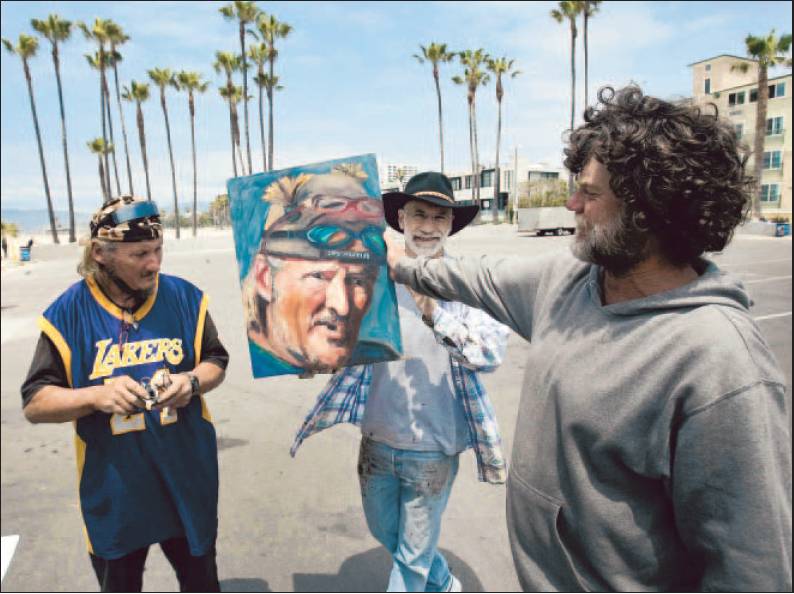
An article in the front page of Monday’s Los Angeles Times carried a similar message. “People are people,” remarked Stuart Perlman who paints homeless people on Venice Beach in southern California (where my son is a cop, by the way). “We’re all them, and they’re all us. We’re all one thin line from being traumatized and homeless.” (“Palette tinged with pathos” by Martha Groves, LA Times, June 11, 2012.)

Stuart pays $20 to have a homeless person sit for a portrait. In return, he gives them an 8×10 version of their painting and always brings some healthy food to share with them. In the process, he hears the stories behind the faces he paints, and incorporates what he hears into the images he paints.

Image the perspective we would have if we took the time to paint the faces of the people around us. Then we would be forced to hear their stories, and in doing so, we would find out what both Stuart and Priscilla found out: We are all more similar than we are different.

Posted in Uncategorized | 9 Comments

The gospel of astonishment

“[The gospel] is not a question to be answered or a puzzle to be solved. It is a paradox to be relished, a wild, outrageous secret to be astonished at and then snitched to the world as the greatest joke ever told… The Mystery of Christ is a festival of weakness and foolishness on the part of God… something that makes no more sense than the square root of minus one — something that is deaf to our cries for intelligible explanations but that works when it is put into the equation of the world — something that can only be marveled at because it is such preposterously Good News. The Bible, from Genesis to Revelation, has one Word for us: God has upped and done the damnedest thing. Or to get the direction and adjectives right, God has downed and done the blessedest thing we could ever not have thought of.”  – Robert Farrar Capon

We celebrate a Gospel of Astonishment. No one enters the kingdom of God on the basis of what they deserve, thus making the overwhelming attitude one of complete and utter astonishment. Based on a true and personal understanding of sin and Grace, nothing else seems appropriate.

It’s the astonishment of the vagabonds and street people who were ushered into the lavish wedding banquet at the last minute because the invited guests had “better things to do.” It’s the astonishment of the workers who got paid a full day’s wage for an hour of work. It’s the astonishment of the Prodigal Son welcomed home with a robe, a ring, and a party when all he hoped for was to simply eat with the servants. It’s the astonishment of Sarah, who laughed a real laugh, no longer cynical, as the baby Isaac was placed in her old wrinkled arms, chalky white and screaming from birth. It’s the thing that will cause all of us to proclaim, when we reach our final destination and first lay eyes on the glories of heaven, “What could I possibly have done to deserve this?”

Here’s what will kill astonishment: The slightest shred of entitlement. Astonishment is like the pregnancy test for grace and mercy. The absence of it is an indication that people have reached spiritual maturation through some other means.

Posted in Uncategorized | 4 Comments

Caught between two mirrors

I wish that for just one time
You could stand inside my shoes
Then you’d know what a drag it is
To see you    – Bob Dylan

I’m sure we all have seen someone who combs ten inches of hair over a wide, shiny bald dome and actually thinks he is hiding something. This hopeless cover-up is similar to whatever we think we are hiding that in reality everyone sees. The problem is, most people, out of common courtesy or more likely fear of embarrassment, don’t tell us what they see. Like talking to someone with bad breath or food on their face, they let us go on to offend or amuse some other unsuspecting soul. The first thing about standing in someone else’s shoes is that you see yourself for the first time without all your blind spots and cover-ups. You see what everyone else sees all the time.

It’s virtually impossible to get another view of yourself by yourself. Just like we need at least two mirrors to see the angles most other people see of us, we need other people to tell us who we really are. People can serve as our character mirrors, and we need to be vulnerable to what they tell us. My wife and children think I look silly when I get mad. My anger obviously is not having the effect on them that I envision. I think they should be cowering, and they are laughing. I interpret their laughter as disrespect, when, if I could really see myself — if I could stand inside heir shoes — I might laugh too.

We need to have people around us who can tell us the truth. This is one of the most valuable elements of the recovery group model. By simply showing up at a meeting you are forced to encounter a different view of yourself than you have been holding most or all of your life. In a recovery group, you are putting yourself among people whom you might have formerly judged as lower than yourself. This is why showing up is the hardest part. You walk into a room full of individuals who all have a problem, and you immediately say to yourself, “I don’t belong here. I’m not really this bad. These are the people who have hit bottom and have nowhere else to go. Me… I’m different. I’m only experimenting with this. I’m just checking it out; I won’t need to be here long. After all, these are all old bald guys.”

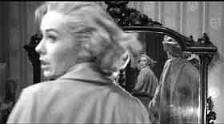
If I use two mirrors, I can see the bald spot on the back of my head that I normally can’t see, and it looks to me to be the size of a football field.

For an honest look at yourself, join our Teleconference Bible study tonight at 7 pm PDT (10 pm EDT). Dial 218/237-3840 and use access code: 124393.

Posted in Uncategorized | 3 Comments

Growing pains

Often, as a child, when I complained about some ache or pain that had no clear physical explanation, the simple parental diagnosis was: “It’s just growing pains.” I used to imagine my muscles and bones actually hurting while they stretched and grew. While I know nothing about the scientific nature of this evaluation, I do know it has a spiritual application that is entirely accurate. It hurts to grow.

It hurts to grow because we have to die to old ways in order to live anew, and old ways die hard. We place a high premium in life on dying peacefully, but in reality dying almost always is accompanied by pain. We have dependencies with coping mechanisms that have enslaved us. It’s hard letting go of our security blankets.

In a touching scene from the romantic comedy, Mr. Mom, Michael Keaton has to coax his toddler’s “whoopee” blanket away from him. Upon rendering it up, the little boy asks for a moment to himself to grieve the loss and we can almost touch his pain. We would like similar moments to grieve our little daily deaths, but we have to learn to move on, because the pain of losing is followed by the greater joy of finding God always meets us on the other side of our loss.

It hurts to grow because growing usually means facing into some fear or weakness that has limited us. Though God saves us through no effort of our own, he asks for our cooperation when it comes to our spiritual growth. Real spiritual growth only happens when our effort to act upon God’s word meets the provision of the Holy Spirit in us.

Or as Paul teaches, “Put into action God’s saving work in your lives, obeying God with deep reverence and fear. For God is working in you, giving you the desire to obey Him and the power to do what pleases Him” (Philippians 2:12-13 NLT).

This is always the spiritual principle of growth. We obey by stepping into our weakness or our fear, trusting in the fact that because it is something He asks of us, He will meet us somewhere along the way with the power to do it. This is almost always a painful proposition because it requires a step into the unknown. What if God doesn’t show up? I suppose we can ask that question, but we will never get the answer on this side of the risk. We have to take the step, believing that there is something there that we can’t see. And if that doesn’t hurt, it’s probably not faith.

Old ways die hard, but new life dances on the gravestones.

Posted in Uncategorized | 4 Comments

Victorious Christian living?

Someone sent in the following question based on a quote from a recent Catch.

The Quote:
“God’s purposes in our lives are… found out by failing to do the right thing and finding out, lo and behold, that God wanted to bring His presence and His purposes (His will) out of our failure. God wants to bring forth life in us, but He can’t do that without a death.”

The Question:
Can you say any more (perhaps in a future Catch) on how God brings his presence and purposes out of our failure? What does true “victorious Christian living” look like after our great fall into his grace?

First of all, “victorious Christian living” is a misnomer, at least what most evangelical Christians have in mind when they hear that phrase is. Victorious Christian living sounds like someone sailing through life, or perhaps I should say, sailing over life, because that is the implication: someone always on top of everything, always happy, always fine. My mother was like this. In the name of victorious Christian living, she always presented to people a sunny disposition, even when I knew that wasn’t an accurate representation of what she was really feeling. I think she felt this was her responsibility; this was her witness.

However, being on the inside made me privy to information hidden to others. I knew that pain, sorrow and sin existed in our family, but it was kept under wraps in the name of victorious Christian living. That made this kind of victorious Christian living a misrepresentation of reality. It was false.

True victorious Christian living is actually spelled out in the verses immediately prior to the one quoted in the Catch: “We always carry around in our body the death of Jesus, so that the life of Jesus may also be revealed in our body” (2 Corinthians 4:10).

It looks like this: “We are hard pressed on every side, but not crushed; perplexed, but not in despair; persecuted, but not abandoned; struck down, but not destroyed” (2 Corinthians 4:8-9).

Notice there is a sustainable reality here, but it is set in the midst of pressure, confusion, harassment, and tragedy. There is nothing hidden here, but there is an undeniable reality of the life of Christ in the midst of these things, making that life even more palatable. This version of the victorious Christian life has nothing put on. It is the real life of Christ in the real struggle of human existence.

I’m sure my mother had an impact with her sunny disposition, but she would have had a much greater impact, and connected in a real way with a lot more people, had she not hidden the things that threatened her faith.

True victorious Christian living would be to experience God’s presence in the midst of the things that try to defeat it, and to live in such a way that everyone around you sees the reality of both.

Posted in Uncategorized | 6 Comments

Can I get a witness?

One of our teleconference participants has lived for some time with a worry that she might get to heaven and find out that nobody is there because of her. This may seem odd to some of you, but I sympathize with it as a recipient of numerous sermons that seek to motivate the hearer to witness to others by applying guilt and fear over what we will have to show for ourselves on Judgment Day. Here’s what is wrong with these messages:

1. Guilt and fear can never be proper motivation for a believer, mostly because neither is supposed to be in our lives. Romans 8:1 tells us there is no condemnation to those who are in Christ Jesus, and 2 Timothy 1:7 tells us that God has not given us a spirit of fear but of power, love and a sound mind. Anyone using either guilt or fear to motivate someone in the kingdom of God is turning back the clock on the cross of Jesus Christ.

2. No one is going to be in heaven as the result of any one of us anyway. People will be in heaven because God invited them. If He used any one of us to deliver the invitation, that will not be to our glory. If we fail He has plenty of other people He can use. Or, as He has in the past, He can use rocks, mountains, trees, the stars, pagan kings, even donkeys, to deliver His messages. Nor will anyone NOT be in heaven because we failed to tell them.

The ministry belongs to the Lord, not to us. This is why Paul can say in 2 Corinthians 4:1, “Therefore, since through God’s mercy we have this ministry, we do not lose heart.” This ministry he’s referring to is God’s ministry. We do not lose heart because God’s work depends on God, not on us. God does His thing with or without us. Our motivation for serving Him is gratitude and a desire to get with His program, and not because He is standing by helplessly waiting for us to “get it” because He has no other alternatives.

If we fail to do what God wants us to do, we miss out, not God. Perhaps you can see this in the lyrics of a song I wrote, “A Witness.”

I will not be without a witness
Will you be a part of this?
 
Many will see without perceiving
Many will hear without believing
Many have longed to see what you see
Before your eyes
 
I will not be without a witness
Will you be a part of this?
 
How will they see unless you show them?
How will they know unless you know them?
If it’s not you it will be someone,
So why not you?
 
Can I get a witness?
I don’t need you,
But I want you.
 
It will be said without you speaking
It will be known without you seeking
But you will be lost in the finding,
And I will cry.
 
I will not be without a witness
Will you be a part of this?

Posted in Uncategorized | 3 Comments

The gate swings both ways

“I am the gate; whoever enters through me will be saved. He will come in and go out and find pasture.” John 10:9

In this pregnant one-sentence parable of Jesus, Christ is in a pivotal place. Jesus is the gate by which we enter into presumably the kingdom of God, but then once we are saved and in a new relationship with Him, He is the means by which we experience the kingdom of God everywhere we go.

This parable is much more complex than it first appears. It is almost like a riddle that begs to let its secret out.

Think about it. If Jesus is the gate that lets us into the kingdom of God, wouldn’t you think we would want to stay in? If we were once outside the gate, and if by our salvation we were brought in, why does Jesus have us coming in and going out repeatedly through that same gate? It must mean that the gate is not something that closes us in anywhere, but it opens up even more to us. It would appear that the kingdom of God is not only on one side of the gate; it is on both sides, and our salvation, more than bringing us into a new place, opens our eyes to see everything anew.

In the context of this passage, Jesus is the gate leading us into His fold, but also leading us out to find pasture where we were before. I find this to be a rather compelling statement of worldview. Once we come into a relationship with Christ, we find a new perspective that allows us to discover His truth both inside and outside the fold. God doesn’t shut us in anywhere; He opens our eyes so we can go anywhere and find that which can nourish our spirits. Faith is not a fence, it’s a swinging gate.

This interpretation would dismiss from Christian thinking, any sense of exclusivity, isolation or separation from the world. It dismisses any form of being “insiders” or “outsiders.” Christ is moving us both in and out and providing us with sustenance and companionship everywhere we go. Being a Christian does not constitute a removal of ourselves from the world; it is all about following Christ into the world — a much needed form of engagement.

“The purpose of gates is to define what is inside and what is outside. Jesus as a gate, however, marks an open passage – a following of Jesus through the death of our old identity as insiders or outsiders – into a new freedom to move in and out between pasture and shelter so that we can be fed without needing to be confined or defended against others. Our identity defined by insider vs. outsider collapses.” – John Kirkley

Posted in Uncategorized | 1 Comment

Alone no more

Tomorrow afternoon I will lead a ten-minute memorial service at the local supermarket for the fellow employees of a grocery clerk who died alone in his home a couple weeks ago. As far as we know there are no surviving relatives aside from an uncle who came to town, had the body cremated and wants no service. Since everyone at the supermarket appear to be his only friends and family, it seems appropriate that they should have their own service for the sake of their own closure and remembrance of Richard, and I have been asked to lead it.

What am I going to say?

Well, after asking a few of them to remember something about Richard – some characteristic that made him unique – I plan to say something like this:

Richard is cherished by God. Everything has been done on God’s end that could possibly be done to secure Richard’s eternity in heaven, and there is no reason, short of Richard’s utter refusal to acknowledge God and His kindness – which is highly unlikely – to think that Richard is not with God right now. Christ died for his sins; he has been forgiven; his sentence of death has been pardoned; and he has a place reserved for him in heaven.

But what’s really important for Richard is the fact that he is being welcomed into a very big family of folks who have been waiting for him to show up. He may have lived and died alone, but he is alone no more.

Blaise Pascal, the brilliant seventeenth-century physicist and prose writer once said that in every heart there is a God-shaped vacuum, and trying to fill that hole with anything but God is ultimately futile and unsatisfactory since it was meant to be filled only by God Himself. To which I would like to add that I believe, conversely, that there is a Richard-shaped vacuum in the heart of God, and that we can take comfort in the expectation that Richard has gone to fill that hole, and that he is supremely happy in the heart of God.

Jesus once said to a small group of people who, like us, were mourning the death of a friend, “I am the resurrection and the life. He who believes in me will live, even though he dies; and whoever lives and believes in me will never die” (John 11:25-26). And then to prove that He had the power and authority to do this, he brought their friend back to life – had him walk out of his own tomb with his graveclothes still on him.

My guess is that Richard is causing laughter in heaven right now with that dry humor of his, and that if he is looking in on us from his place there, he would want to say, “Hey you guys… it’s true. All that stuff about God and Jesus and heaven? It’s all true. You guys might as well start enjoying it now. Don’t wait until you get here.”

And then I plan to pray.

Don’t forget: Tonight is our teleconference Bible study and discussion: Transforming the Marketplace. Be ready to share with me some of your thoughts about this talk. All are welcome.
Time: 7pm PDT, 10pm EDT
Dial: 218-237-3840 and use the Passcode #124393

Posted in Uncategorized | 7 Comments

In appreciation

Today I write to you in appreciation of a very stellar person in my life. She has consistently believed in me from the time we first met until now. She has believed in me against all odds, when I have lost my sense of who I am and what I am here for. She sees the vision when I can’t. She is constantly calling me out of the small, insignificant places I would prefer to hide in, and reminding me of a bigger calling.

She is, in every way, a Proverbs 31 woman.

She sees that her trading is profitable, and her lamp does not go out at night. (v.18) Hardly ever. Sometimes I wish it did so I could get some sleep.

She opens her arms to the poor and extends her hands to the needy. (v.20) It’s a natural reflex. Her hands are connected to her heart when it comes to those who cannot help themselves.

She makes coverings for her bed; she is clothed in fine linen and purple. (v.22) This is her trademark and indicative of her dignity to dress well and surround herself with beauty, and though some misunderstand her in this, she remains true to who she is. She requires a level of dignity, but no higher than what she gives to everyone around her.

She speaks with wisdom, and faithful instruction is on her tongue. (v.26) People come to her house to be instructed. People seek her out. She is full of wisdom, encouragement and good advice.

She watches over the affairs of her household and does not eat the bread of idleness. (v.27) Idleness? It is not in her vocabulary. She has two speeds: “Thoroughly engaged” and “Off.”

Charm is deceptive, and beauty is fleeting; but a woman who fears the LORD is to be praised. (v.30) It’s also true that a charming, beautiful woman who fears the Lord is… well… quite a find.

Sometimes I send her my Catches ahead of time — far enough ahead to effect changes from her perspective. (You have been spared what you don’t even know, thanks to her.) But she hasn’t seen this one. I want the first time she reads this to be the same time most of you do, because, before these witnesses, I want you to know, Marti, how much I appreciate you.

Posted in Uncategorized | 9 Comments