The Wizard of Uz

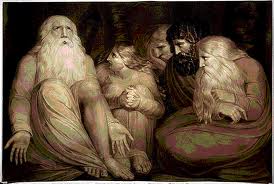
In the land of Uz there lived a man whose name was Job. What did this man learn from his life – from the pain and suffering, the wise and unwise counsel, from all the unanswered questions – 288 of them to be exact, including 78 questions from God?

Even after his health and wealth were restored, he never knew that God and Satan were bartering over his soul in heavenly places. He never knew that his story was going to be chronicled in the most important book in history and read for thousands of years by millions of people, that it would be pored over and picked apart by generations of scholars, that it would continue to be debated in the classroom and literary halls of history, that indeed whole volumes of books about him would stand in seminary libraries, and songs and plays would be written and performed about his life.

All he knew was that things were going along swimmingly for a while, and then suddenly everything got really bad, and then it got good again. Did he ever get his questions answered? No, but he did see God, and apparently that was enough. “My ears have heard of you but now my eyes have seen you,” declared Job after facing God’s 78 questions. “Therefore I despise myself and repent in dust and ashes” (Job 42:5-6).

What did Job do to repent of? “I spoke of things I did not understand, things too wonderful for me to know” (Job 42:3).

He spoke too soon.
He tried to answer questions he had no business answering.
He tried to explain his life.
He tried to put tab A of his theology into slot B of his experience, and it didn’t fit.
He tried to make sense of his life instead of learning to live it, regardless of what was happening to him.

I think a similar repentance is in order today from people who often speak to soon. We have rushed to fill the void where only wonder should be – wonder, and doubt, and suffering, and ambiguity, and worship. We have knelt too freely at the cultural shrines of easy answers rather than live a courageous asking, seeking, knocking life – open, honest, and needy before the Lord and before the world.


Posted in Uncategorized | 5 Comments

Rules of the game

If a generation that started with questions and ended up with Jesus tried to start the next generation off with Jesus, wouldn’t that generation eventually have to go back to asking questions – the very ones it already has the answer to? Can you find Jesus without looking for him? Can you have the answers without going through the questions? Is it possible to circumvent this natural process of seeking and finding?

Is it possible to have all this dropped in your lap? Can you receive, find and enter without asking, seeking and knocking? Well, I suppose you can, but wouldn’t it be rather rude and presumptive not to knock first? If a person has come by all this so easily, who’s to say it wouldn’t be just as easily taken away? After all, “Easy come, easy go.”

In seeking there is a glory that must be guarded. The parables of the lost sheep, the lost coin, and the lost son show a persistent Father bent on finding. Amazingly, God plays this game by the same rules as we do. If he is that persistent about finding us, how can we expectant to get to him any more cheaply?

Posted in Uncategorized | 4 Comments

On this side of the answer

We need not be in such a hurry to race to the answer. We need to allow some time on this side of it – to feel not the abrupt silence after the answer but the pregnant one before. To linger in the question, to hold it, to turn it side to side, end on end, to catch the light on the question’s many angles, to see it reflected in each person’s perspective, through each person’s eyes, to spend a whole evening pushed back from the table, watching the light of truth bounce off all its many faces, is to follow, as a king would follow, the glory of the quest.

Answers are as alive as questions; they grow with experience. The answer is the beginning and the middle as much as it is the end. If Jesus is the answer, then he is to be experience anew, afresh, in each of our lives – in our doubts, in our dreams, in our questions, and in the silence that sometimes is the only real answer that can follow.

Three simple words that will ruin any conversation: “I know that.” When my daughter was in grade school, this was her favorite phrase. I can remember testing her on her homework, correcting her incorrect attempt, and she would come over and look at the word on the paper to be sure I was right, and then she’d say, “I know that.”

Most people get better at this technique as they grow older. The word need not be said; the effect is known and felt by everyone. It’s a downward look from an upturned face, or the wrenching of a body backward after depositing the weight of a heavy verdict, or merely the stiffening of a neck, but it’s still said, plainly and clearly, through an impregnable wall: “I know that; I read that book; I know how it turns out.”

It is impossible to share a discovery, to give a version of a story or a possible solution to a problem, to bring out one’s humble treasure in front of such a person without being crushed.

I wonder how much crushing I’ve done in my life. How many times have I assumed people knew nothing about the truth while I knew everything? How many times have I shut the door on someone else’s search? How much of this beautiful interplay of light and faces have I missed, waiting to close the curtain on my final act… to close, and not to open?

If it is the glory of God to conceal a matter and the glory of kings to find it out, then to resolve a matter, to shut a door, to end a discussion, to win an argument, to crush a child’s first try must be the glory of fools.

Posted in Uncategorized | 5 Comments

Hourglass Faith

Jesus never closes a mind: he opens it. Jesus is never threatened by a question: he welcomes it. He knows all questions will ultimately end up with him, so fire away!

Jesus is the answer, and when he walks through a question, he always leaves the door open so anyone can get to it from either side. We want to shut the door (once we’ve passed through it, of course). Bad idea. Leave the door open.

For many Christians, the experience of truth has been a narrowing one, and in one sense this is right. All those questions – religions, sins, frustrations, explorations – finally ended up with Jesus. Like following the inside of a cone, all experiences funneled to a point, and at that point was Jesus on the cross for my sin.

The error, however, is when we stop there and move no further. For our experience of truth to grow, we must move through the cross back out into the same reality – the same questions, the same world – with a different perspective.

It’s like an hourglass with the cross at the center. All my pre-conversion experiences narrowed me toward a personal encounter with Christ; but once through, he leads me back out into the world I came from where the lines now, instead of converging, open up into an ever-widening reality. The sands of truth always move this way – in toward the center and out again.

Yes, Jesus is the answer, and it’s precisely because he is the answer that we can venture out. Because he is Lord of all, we can walk into “all” and find him Lord. This is not only a privilege, it’s a mandate. It’s what we are called to do in the world.

Posted in Uncategorized | 4 Comments

When answers are idols

In some cases we learn more by looking for the answer to a question and not finding it than we do from learning the answer itself.

— Dallben, from The Book of Three by Lloyd Alexander

Is the Bible a Book of Answers? Is its primary purpose to provide us with a manual for life? Do we approach the Bible as if it were a sacred vault from which specific answers can be mined – answers that will make our lives successful?

Good things can become idols. Even the actual graven images of the Old Testament were not bad in and of themselves. Some were probably admirable works of art. A thing becomes an idol when it is placed before, or in the place of, the living God. The idol can be anything – a piece of wood, the sun, the Bible, a person, or a system of answers that explains reality sufficiently for one’s own experiences.

To come to God seeking anything but himself is to come with insufficient need. A person seeking answers to life’s questions is not asking for enough. And when someone else provides the answers to those questions, he may – intentionally or not – be doing away with another’s need for God. Subtle, these things we place as other gods before God.

We seek the security of a closed system that promises answers to life’s questions long before we are interested in seeking a God who withholds them. We study the Bible as a problem-solving workbook long before we approach it as a doorway to an awesome, holy, not-to-be-pandering-to-anyone God.

Dallben was right: We learn more by not finding the answers, because in our need for answers we are most likely to find God. You can’t have God and have your questions answered at the same time. Answers too often turn into idols.

Posted in Uncategorized | 5 Comments

Questions and Answers

Yesterday’s Catch began with a quote from the writings of Holocaust survivor, Elie Wiesel, and one sentence in particular deserves a closer look: “Every question possessed a power that did not lie in the answer.”

How is it that the question has a greater power than the answer? Why does the power not lie in the answer? Because then the search would be over. End of story. No challenge, no debate, no discussion, no speculation, no wondering, no mystery. Just answers.

Answers lead to arrogance, to being right, to lording it over those who don’t. Answers lead to control, to proving others wrong, and those with all the answers would hold all the cookies.

But there is a greater power in the question. The question leads to the power of faith, the power of a child, the power of weakness. Questions bring us together in humility. Questions make us need each other. They lead us on quests, and they lead us to accept the help of others who are seeking the same thing.

Questions force our minds open; answers close them.

Now there are some answers (usually the right ones) that bring with them a whole new set of questions such as Jesus. Jesus is the answer, but we’ll never get to the bottom of that question.

And that’s good!

Posted in Uncategorized | 3 Comments

Questions

“Why do you weep when you pray?” he asked me, as though he had known me a long time.

“I don’t know why,” I answered, greatly disturbed.

The question had never entered my head. I wept because – because of something inside me that gelt the need for tears. That was all I knew.

“Why do you pray?” he asked me after a moment.

Why did I pray? A strange question. Why did I live? Why did I breathe?

“I don’t know why,” I said, even more disturbed and ill at ease. “I don’t know why.”

After that day I saw him often. He explained to me with great insistence that every question possessed a power that did not lie in the answer.”

— Elie Wiesel

Questions leave us vulnerable, weak, needy. They open up gaping holes in our personality, our theology, or our lifestyle. Questions force an honesty that we are unwilling to confront – an honesty that requires us to live with our lives unresolved. We don’t like that. Especially when we’re trying to sell a theology that has an answer to every problem we face.

I once counted 288 question marks in the book of Job. Many were from the mouth of Job; others were spoken by his counselors. But surprisingly, when God finally speaks in the closing chapters, his answer to Job comes in the form of more questions – 78 of them, to be exact. Of the 288 question marks in the book of Job, 78 of them belong to God; they are his answer to Job.

Sometimes God answers us with questions – questions that leave us humble, awed, speechless, weak, and believing – believing not because we’ve found the answer, but because we’ve seen God. It doesn’t matter that we have more questions now that when we started. It matters that we see God, for in the seeing, we discover that the truest answer to all our questions is to worship God.

Posted in Uncategorized | 7 Comments

The ambiguity of Jesus

There’s no way around it – Jesus was ambiguous. He always seemed to send people away scratching their heads – even his disciples. He was not a man with easy answers. He never gave a three-point message. His sermons don’t outline very well.

His favorite phrase when speaking a public message was “He who has an ear, let him hear.” Hear. He used it as an activity – something that some people do with their ears, but not necessarily everybody.

Jesus had a favorite method of speaking to people. He put it in a story – a parable. When his disciples asked him why he spoke to the people in parables, he replied: “The knowledge of the secrets of the kingdom of heaven has been given to you but not to them. Whoever has will be given more, and he will have an abundance. Whoever does not have, even what he has will be taken from him. This is why I speak to them in parables” (Matthew 13:11-123).

Thanks, Jesus. That about clears it up. You speak in parables and you answer in riddles. “He who has…” He who has what? Cars, boats, swimming pools, friends, truth? What does he mean? Now we have two questions: “Why did he speak in parables?” and “What does his answer mean?”

To each of his disciples Jesus simply said, “Follow me.” That was an invitation, not a requirement. An invitation respects the freedom of the invitee to accept or decline. Indeed, the “no” answer is perhaps the greatest expression of human dignity possible. That men and women can go to heaven is an expression of God’s love; that they can go to hell is an expression of the value he places on their freedom,

God desires – not requires – a relationship with us. It is not a one-sided affair; we are co-participants with him, both in our relationship with him and in our work in the world.

A woman with a hemorrhage struggled through the press of the crowd in order to touch his garment; four men opened a hole in the ceiling of a crowded house and let down their paralyzed friend in front of Jesus; a centurion soldier asked that Jesus only speak a word so his servant would be healed; a blind man went and washed the clay and the darkness from his eyes; a little boy offered his meager lunch to feed a multitude. Even the miracles of Jesus involved human participation. This was not just a Messianic Magic Show; this was God interacting in human experience – giving and taking, relating with us as Son of Man.

God does not pull all the strings. He counts us as too important for that. To find without seeking, to hear without listening, to say yes without the possibility of saying no is to negate the value of my seeking, my hearing, and my participating. I am not a puppet.

Posted in Uncategorized | 8 Comments

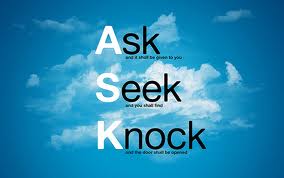
Ask, Seek, Knock

“Do you want to get well? – surely one of the most important questions Jesus ever asked anyone. The answer is not as obvious as it may seem. Even the man to whom it was addressed didn’t give a direct answer. An invalid for 38 years, he responded by muttering something about never being able to get into the healing waters of the special pool. Why not a simple “Yes”? Why not an enthusiastic and glorious “Yes!”?

No doubt he didn’t realize the Lord of the Universe was speaking to him. But even that knowledge might not have guaranteed a different response. Thirty-eight years is a long time to settle into the comforts of being an invalid – of always having an excuse. Being well holds more responsibilities. Jesus wanted to know what the man wanted.

He wants to know the same from us. Jesus can do little for us if we are comfortable with our place, if we have made compromising alliances with our losses and excuses for our inability to change. Too often we languish in our condition when all along, Jesus stands there asking, “What do you want?” And if we don’t languish, then we lull; we settle for less.

Though physical healing may be involved, it is not the main point. Jesus’ question refers to life itself, What do you want from life? What do you want from me? “Ask and it will be given to you; seek and you will find: knock and the door will be opened to you.” Then he repeats “For everyone who asks receives; he who seeks finds; and to him who knocks, the door will be opened.”

The first statement is a formula – a cause and effect proposition – do this, and this will result. The second has a different emphasis – on the person, not the formula. “For everyone who asks… he who seeks… to him who knocks…” Jesus is talking about a type of person. God’s economy rewards the askers, the seekers, the knockers.

In the end, the process is quite simple: I ask because I don’t know the answer; I seek because there’s more to find; I knock because this door goes someplace.

Posted in Uncategorized | 5 Comments

‘That I may know Him…’

God shows up wherever He wants. He is the rewarder of those who earnestly seek Him, and seekers know there is still more to be found.

Paul was one of those seekers and he gave us a clear indication that his search was never over – his longing heart never fully satisfied.

“That I may know Him…” he wrote. Knowing Christ was his driving passion, the motivation for which he was willing to give up everything.

“That I may know Him…” When did Paul write this? While he was sitting in Damascus waiting, blinded by the revelation of Jesus Christ Himself?

Or was it when he was in the desert for fourteen years, hearing directly from God, “consulting no man”?

Maybe it was right before he was caught up into the third heaven, when he didn’t know if he was in or out of the body. Or before he was caught up into Paradise and heard inexpressible things, “things that man is not permitted to tell.”

No, it was after all that. After the missionary journeys, after the shipwrecks, after the beatings and imprisonments, after so many miracles, after the founding of many churches. While he was in prison in a Roman jail cell, Paul penned this great passion of his soul: “That I may know Him…”

If finding was the end of seeking, then Paul would have never written this. And if Paul was still seeking near the end of his life, what does his search say to us?

Posted in Uncategorized | 6 Comments