
Coming alongside

I am normally not a fan of ten steps to this or five ways to do that. But for one of my recent talks I came up with these six things to remember about being around those who may not yet be Christians, and thought some of you might find it useful.

1) Assume everyone is searching for God. Why? Because everyone is. We were created this way. God has purposely frustrated humanity by creating us with eternity in our hearts, yet with an inability to fathom what that is or what it means (Ecclesiastes 3:10-11). He has done this so that we might reach out for him and find him though He is not far from any of us for in Him we live and move and have our being (Acts 17:27-28).

2) Come alongside. This is really the crux of it all. Just walk alongside people and enter into their lives. Listen. Talk. Laugh. Cry. Find out where you can contribute and what you can learn. There’s something to give and something to receive in every relationship.

3) Point. You don’t tell someone what the truth is; you point to it. “There it is over there,” or “Here it is in my life.” This is why we need to learn to identify truth in the context of the world around us. Truth isn’t religious. You don’t have to get into a certain posture to see it. It’s not something that hasn’t been there all along.

4) Find out what people already know before you set out to tell them anything. Don’t ever think you have to clear the table and start over. This is why it’s so important to listen first. Find out what’s already on the table that you can use.

5) You don’t have to tell everything you know. Just the next thing.

6) You don’t have to correct everything someone says that is wrong. You are not the protector and defender of truth. You don’t have to decide where to draw the line. You don’t even have to be concerned if someone may be walking away with the wrong idea. You are not that smart anyway because you don’t know what’s in someone’s head. As long as they have something to think about, that’s a good thing.

And now here’s the one final thing that makes all this possible. It is the most important of all. (This is the one thing that makes all six of these make sense.) We don’t save anybody, convince anybody, “win” anybody to Christ or close the deal. All that is God’s business. The Holy Spirit is doing this all on His own terms and timetable. We are not salesmen, marketing reps, counselors or prosecutors. We are just friends who come alongside.


Posted in Uncategorized | 18 Comments

Who’s next to you?

“There are two types of people in the world. Those who divide the world up into two kinds of people and those who don’t.”

Interestingly, both Paul and Jesus divided people into two groups. Paul describes these groups as those who are “being saved” and those who are “perishing” (2 Corinthians 2:15 NIB), and Jesus describes them as the sheep and goats he will separate on the last day (Matthew 25:32). And in another parable, they are the wheat and the tares that are growing, in some cases side by side, so that pulling up the one might destroy the other. So Jesus said to let them grow together until the harvest. (Matthew 13:24-30)

All three of these descriptions have to do with the ultimate destiny of people’s souls, and the information is confidential. So let them grow together, said Jesus—the wheat and the tares, the sheep and the goats, those who are being saved and those who are perishing. We’re all in this mix together and none of us is completely certain about the outcome of the people around us. This is why you always point everyone to the truth.

So let them grow together also has an implication of close proximity. Right next to you. Because we never know about people, we can be hopeful about everyone. You want to treat everyone with equal value. As far as we are concerned, there is only one kind of person — the one God loves… the one for whom Christ died. All other judgments are simply not in our jurisdiction.

“There are two types of people in the world. Those who divide the world up into two kinds of people and those who don’t.” Be among those who don’t.

The Lord is not slow in keeping his promise, as some understand slowness. Instead he is patient with you, not wanting anyone to perish, but everyone to come to repentance. (2 Peter 3:9)

Posted in Uncategorized | 2 Comments

Bedside wisdom

Our daughter, Anne, is just two weeks away from graduating with a degree in medicine from the University of Southern California. Her last rotation has been in E.R., which is her favorite. She is so well suited for this position that most E.R. doctors don’t consider her a student; they just throw her into the action and know she will survive.

So it was that she ended up last week sewing up the hand of an 80-year-old man who had gotten it caught in a meat grinder. It turned out to be a three-hour ordeal for Anne that brought new meaning to the term blood, sweat and tears.

First, Anne treats every patient as if they were a family member, so for her, it was my hand she was sewing back together from an impossible state of jagged edges, loose flaps and missing skin. The old man, sensing Anne’s concern, said, sweetly, “Don’t worry; I’m 80 years old, I don’t need that hand for much anymore. It doesn’t have to be perfect.” This, of course, made her want to try even harder.

Second, the man had prostate problems and had to keep getting up to pee, of course, at crucial times in Anne’s delivery. Towards the end of the operation, when he tried to get up to go again, Anne stopped him and said, “Oh no you don’t! Not ’til I’m done!”

Not to mention the other man at death’s door, behind a curtain in the next bed, moaning and crying out, “Lord, help me. Lord, help me.” This made Anne feel especially empathetic towards her 80-year-old patient, wondering how he was dealing with these desperate cries to God for help.

She got her answer when he leaned in and whispered, not bothered in the least by the dying man’s pleas: “That’s how you know you’re still alive.”

Have you done any crying out to the Lord for help lately? Good, because you wouldn’t be alive if you weren’t.

Posted in Uncategorized | 7 Comments

Declaration of a marketplace Christian (Part 3)

[Thank you for participating in this discussion over these last three days. We will be publishing all three parts as a whole on a separate page of our website where we can continue the dialogue, add to it, and make changes. It is not meant to be a static document, but a means of raising awareness and pinpointing ways in which we differ from traditional thinking.]

Whereas:   We are followers of Christ who are wary about things that are given the cultural label “Christian”; and

Whereas:   “Christian” has become a term that has more to do with how one aligns oneself politically and socially, or how one behaves in relation to certain cultural mores, than it does with anything of the heart; and

Whereas:   We want to be Christians – but with a new definition;

We have come to the following conclusions:

We do not have to determine whether a person is a Christian or a non-Christian before we know how to talk with him or her.  We speak to everyone in a universal language. Some may be drawn to us; others may be repelled. We do not know who is who – nor is it our responsibility to figure this out; we only point the way.

We can be fearless in the world because we know that Jesus is praying for our protection (John 17:15), and there is no power on earth or in heaven that can stand against Him.

Therefore, and for all these reasons, we do not have to hide in a subculture, nor do we have to spend all our efforts fighting society. We are not at war with the world. We love the world as God does because it is full of people for whom He gave His Son so that those who believe in Him might not perish but have everlasting life.

Since Jesus did not come into the world to condemn it, neither will we. And since, instead, Jesus came to save the world, we will put all our efforts to that end, knowing that He has already completed all the work necessary to save people. It remains only for us is to let them know.

Posted in Uncategorized | 9 Comments

Declaration of a marketplace Christian (Part 2)

[Note: Yes, I realize that yesterday this was a manifesto and today it is a declaration. That is because my good wife said she didn’t read it yesterday because she didn’t know what a manifesto was. Well I had to admit I wasn’t sure either but that it sounded really good. To that she suggested I stick to things I know instead of trying to be something I am not (like an intellectual), so it is now a declaration, meaning it contains a number of beliefs and perspectives on the world that we believe are necessary in order to interact in the culture in which we live instead of remaining separate and aloof. This list is by no means complete, but more of a beginning to get the discussion going. Please let me know what you think and if you have something to add. Because I believe these things are central to our work here at the Catch, we will be putting it in a permanent place on our site where we can refer to it and watch it develop.]

Whereas:   We are followers of Christ who are wary about things that are given the cultural label “Christian”; and

Whereas:   “Christian” has become a term that has more to do with how one aligns oneself politically and socially, or how one behaves in relation to certain cultural mores, than it does with anything of the heart; and

Whereas:   We want to be Christians – but with a new definition;

We have come to the following conclusions:

We realize that we live in a world dominated by secular minds and philosophies. Because of our love for all people and our desire for them to know the love of Christ, we choose to learn about and interact with these philosophies rather than categorically reject them. When it becomes obvious that we have to part ways with the world to avoid compromise of our beliefs, we will do this in such a way as to not judge others who don’t feel as we do.

Though our hearts are connected to eternity, our feet are firmly planted on earth. For this reason we will strategize, barter, study and grow in two kingdoms. We have found that these two kingdoms need not always be warring against each other. We have found the things of God in the earthly world, and we have found evil in the kingdom of heaven, just as the parables of Jesus indicated we would.

We have learned to appreciate the artistic expressions of those who may not be following Christ. We will not begin with the assumption that they are wrong so that we can condemn them, but with the belief that they are right about something so that we can communicate with those who value their work.

We will not be threatened by “other paths to God” knowing that there is only one God and one way to reach Him, and if people are truly seeking Him, they will ultimately find their way to Christ even if they started out by way of another path.

We believe that wherever we go, God got there first. This means at least three things:

1) There is always something to find and embrace in the world, since God’s truth is everywhere.

2) We are never alone because there is nowhere we can go on earth or in heaven where God is not present.

3) There are many shoulders people are riding on other than our own. We do not have to finish everyone’s search; we are merely helping them along the way. If we happen to be there when someone comes to Christ, we will be overjoyed, but we will realize we are only part of a long line of witnesses who have prepared the way.

[…to be continued.]

Posted in Uncategorized | 16 Comments

A Marketplace Christian’s Manifesto (Part I)

Whereas:   We are followers of Christ who are wary about things that are given the cultural label “Christian”; and

Whereas:   “Christian” has become a term that has more to do with how one aligns oneself politically and socially, or how one behaves in relation to certain cultural mores, than it does with anything of the heart; and

Whereas:   We want to be Christians – but with a new definition;

We have come to the following conclusions:

We are not trying to create a place of safety in the world. Instead, we have found a place in our hearts where Christ dwells, and this gives us courage to face the world as it is.

We realize our overall purpose is not to change the world (that kind of thing is beyond our control), but it is to bring comfort, peace, warmth, love, and aid to people who are in the world, in the name of Jesus and His gospel.

Even if we were able to control the moral standards of society we understand that we would not necessarily be furthering the cause of Christ by making people better. In fact, we recognize a selfish motive in wanting a better world so we can have a safer environment in which to live and raise our own families. This gives no regard that to the fact that “better” people without Christ still perish in their sins. A more moral society means little or nothing if people do not come into relationship with Christ.

We may not look or talk like traditional Christians because we hang around non-Christians a lot and have learned to play down our differences rather than exploit them, as some Christians before us. We have discovered that by identifying with sinners we are in a better position to introduce them to Christ than when we remain separate and aloof because we think we are “different” (which usually translates to “better” in their minds). The only people who are looking for perfect Christians to model their lives after are other Christians who have bought the lie that perfection is attainable.

We will not be offended by the language and behavior of non-Christians. We realize, because we know ourselves, that sinners sin. There is no reason to be appalled at this. If we were perfect and had no sin of our own, we could be appalled, but we are not without sin. The only thing that should offend us is the same thing that offended Jesus: self-righteous hypocrisy. We realize that in choosing to be offended by the normal behavior of non-Christians, we are turning ourselves into the very thing Jesus hated. We, who are worried about being offended, make ourselves an offense to God.

We have decided not to put any real stock in having famous people endorse Jesus and have concluded we would be happier having Jesus endorse us. Character is superior to fame and glory.

Posted in Uncategorized | 15 Comments

Easter bunnies and resurrection power

This morning, the house gives evidence of the Easter holiday. Red and violet tulips stand straight and tall on the dining room table. Little bunnies hop on windowsills. A pot of yellow daffodils peeks out the kitchen window. Easter baskets from yesterday still contain yet uneaten chocolates and jellybeans buried in cellophane grass. An Easter lily stands in front of the fireplace, it’s five freshly opened, pure white flowers trumpeting the arrival of spring, echoed by the mockingbird outside my window who has been going all night.  Colored eggs are stacked in the refrigerator waiting to be cracked open and eaten. Everything is bathed in pastels.

As Beverly’s poem pointed out yesterday, it’s not about eggs and bunnies; it’s about what Christ did for us on the cross, and what he won in his resurrection. But knowing this doesn’t mean we have to do away with the cultural icons of this season. You can have your eggs and bunnies and your resurrected Christ as well.

Much of what Christians have thought was their witness in the world has relied on a sort of cultural antagonism that pits the gospel against secular influences as if they were mutually exclusive. They aren’t. After all, God invented spring. He put the mockingbird outside my window, and God was the one who put resurrection power in a flowerbed. We don’t need a culture war in order to be distinctive. A lot of that is artificial.

Christians love to manufacture what makes them different from the world instead of embracing what makes us the same. Don’t you think the gospel can travel better on a track that affirms what is culturally true instead of always pointing out what is wrong with the world? No wonder non-Christians cringe when they see Christians coming. We are such cultural killjoys.

There is so much in the world that already affirms the truth. Let’s focus on that instead of creating enemies.

Posted in Uncategorized | 10 Comments

Easter greeting

Easter message

Click for an original Easter poem from a women without a home.

Posted in Uncategorized | 7 Comments

Unintended crosses

One of the marks of a Christian in the world is to always be in a state of readiness to be surprised by God. Why not, since He is everywhere, and our inability to see Him is more a factor of our not seeking Him than anything? It can happen anywhere, anytime you put your mind to it. Put yourself in a place of expectation and get ready for a surprise.

Why just a couple days ago, I stepped off a curb in between two cars, looked down, and saw a 3-foot long white cross painted on the pavement with oil stains on it. Now some people probably might think this is a divider marking the space between two parked cars, but that’s just its excuse to get painted on the street. It’s really a cross. Ask anyone to take a good look at it and they will all agree: it’s a cross. A perfectly proportioned cross. Hundreds of them line the street on both sides for blocks like freshly painted Stations of the Cross, downtown.

It’s certainly a poignant image for today, especially – the day we remember, of all Friday’s, the one that forever made the difference in the way God looks at us. For now, when God looks at you and me, instead of our sin, He sees Jesus.

So here is a cross in the street, stained with the dirt of our lives that has been forever removed from us. You probably have one of these crosses near you.

Something tells me the women of Isaiah House would especially like these crosses in that they are on the street, they’re a little dirty, and they are unintended. I’m sure none of them ever intended to be where they are, but here they are nonetheless, and like these crosses in the street, it’s good to know that God got there first.

Crosses do this for us. They help us remember. Such a strange symbol to be chosen as a Christian’s most recognizable – a symbol of torture turned into a symbol of hope. Try it today, and you’ll find crosses everywhere – in the sky, on the ground, in the hands of a clock, in the profile of a dancer… I’m looking at four right now in the panes of my window. Mercy, love, forgiving and forgetting, coming soon to a cross near you!

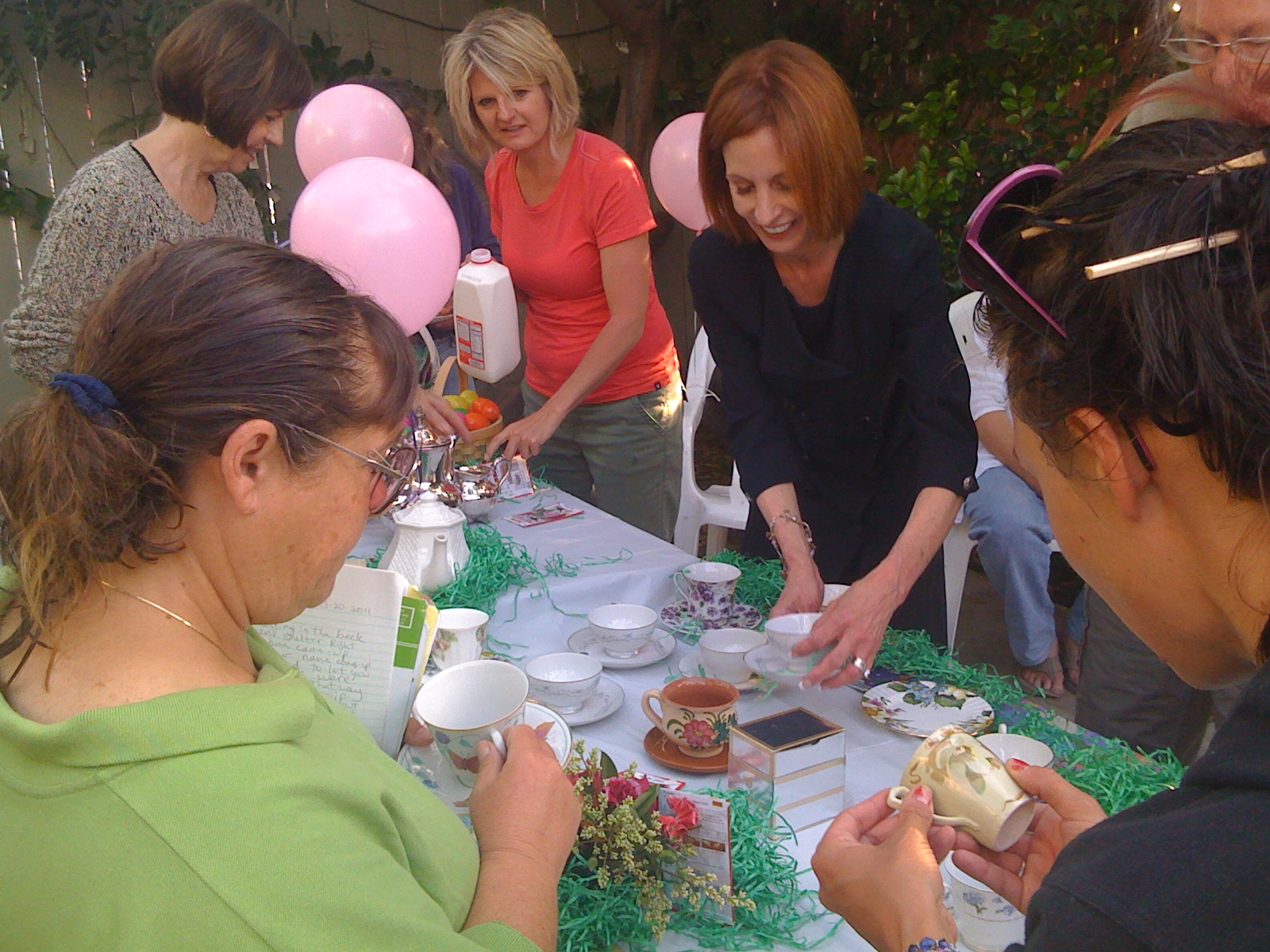
We’d like to take this opportunity to thank those readers of the Catch who participated in this last Isaiah House event by sending beautiful cups and saucers for us to share with the women. They loved these gifts. Our list my not be complete so our apologies if we missed your name. Thanks to: Shari Yamamoto , Elling Morton, Connie Hernandez, Peter Hollingsworth, Diane Sailor, Weatherly, Paulette Bouchard, Peggy and Kent Savage, Laquita Showen, Lynette Schoefer, Julie Wilson Hamington, Frank and Louana Lopez, Joyce Elling, Beverly Peters, Donna Phebus, Betty Middleton, Jan Day, Dana Stenholtz, Sracia Stenholtz, and Harriet Hughes.

Happy Easter to you and to all within reach of the Catch of the Day!

Posted in Uncategorized | 2 Comments

Mother and child

April showers were held in custody by the prayers of the faithful. In the fading light of day’s end a mother sits with her child who turned 14 yesterday, laughing and talking to, I think, hide their tears.

“It’s time for tea,” a volunteer encourages, but the child is shy, shivering. Is it because it’s chilly?

“Time to plant those tears,” the mother suggests as she hands her daughter one of the many beautiful teacups provided and fills it with potting soil. “Go ahead. Pick your own small garden from the flowers pictured on these packets of seeds.”

You were with us yesterday at the Isaiah House Garden Party represented by the teacups you provided from your own cupboards – so you know the mother and child’s sorrow that was transmitted by the Holy Spirit from the common human experiences of sadness, joy, and embarrassment that are shared equally by those with homes and those without one.

We all know the sorrow that we cover in laughter and jokes and can recall how the threat of rain can make us feel more lonely and broken-hearted. In contrast to a child’s new birthday, we try to reconcile with our own fading light that is not only linear but also circular, spinning like the seasons of the years. We are all more similar than we are different.

“It is time for tea” is between any generation, regardless of where we live, not only our departure point, but the destination of our daily lives with all their ups and downs.

It is time to plant our own tears of uncertainty with seeds of hope that flourish like a flower bed, which is, of course, the future of others, revealing that it is time, regardless of the season, to enjoy the experience of human life – for both the child and her mother – for both you and me, whether we are at home or out on the street. This is because the conflicts we face are an inevitable part of life and are designed to serve as a catalyst connecting us all. Instead of avoiding conflict or making laughter and jokes about it, it is time we recognize that conflict is the one element we are not facing in our Christian life – a voice of reconciliation, showing Christians, un-churched, and seekers that conflict is also an opportunity to learn and grow, and often to grow closer.

It is time for tea. It is time to plant our tears in the teacups from generations past. It is time to select our own small garden from the seeds of new life displayed on the face of our Lord Jesus Christ.

[Marti’s reflections on last night’s Isaiah House Garden Party]

Posted in Uncategorized | 2 Comments