
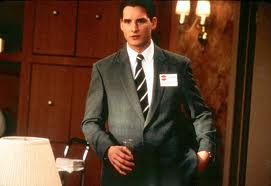
 I know I’ve used this movie before but I can’t help it. Never have I witnessed a part, a character or a situation as a dramatic production that is closer to my deep-seated fears and misassumptions than what I find in the character played by Peter Facinelli in the movie The Big Kahuna starring Kevin Spacey and Danny DeVito.
I keep coming back to it because I have quotes from it in my speaking notes and when I go on the road and prepare for a new talk I run across them again and sometimes I find something new that didn’t hit me as strongly as it did before. Probably because I wasn’t ready for it. Truth is always like that.
Peter Facinelli, who plays Bob in this movie, is a perfect example of a kid who grew up Christian, went to a Christian college, took on all the trappings of what a Christian is supposed to be and do, and truly means it, but when thrust into the real world with two seeking individuals who to him would simply be non-Christians, the holes in his character, the missing links of humanity, the inability to connect with what should be naturally human become glaringly obvious. So much so that towards the end of the movie, Phil (the Danny DeVito character) makes an observation, “Your problem, Bob, is that you haven’t lived long enough to regret anything.”
To which Bob replies, “You’re saying I have to go out and do something bad so I’ll have something to regret?” (Exactly what I would have said, by the way.)
Phil: “I’m saying you’ve already done plenty of things to regret you just don’t know what they are.”
Ouch! That’s the part that always nails me. But then he goes on to say: “It’s when you discover them (the things you regret), when you see the folly in something you’ve done, and you wish that you had it to do over, but you know you can’t, because it’s too late. So you pick that thing up, and carry it with you to remind you that life goes on, the world will spin without you… Then you will gain character, because honesty will reach out from inside and tattoo itself across your face.”
This adds new meaning to “pick up your cross and follow me…” Instead of dragging around some imaginary bloody beam of wood, what if Jesus meant for us to face into the failures, disappointments and mistakes of our lives and own them instead of excusing them or skating over them, and let them become a part of who we are and are becoming? Pick them up and carry them around as reminders of why there had to be a cross in the first place. So many of us are like Bob: trying so hard to be good Christians that we wouldn’t recognize our own cross if we tripped over it. Our cross is all the things we should be regretting but don’t know anything about. Believe me, I can speak with understanding about this because I keep tripping.
Picking up your cross then would mean moving on in spite of your mistakes, failures and regrets. It would mean growing through regret and forgiveness, and finding hope on the other side of the cross.
…and true character.





 John Fischer The Catch
Is that not the difference between Peter and Judas? The one owned his failure or weakness and the other was not able to accept what he had done by his betrayal. Although both had betrayed the same man, one accepted the grace of forgiveness and one could not. One tried skating over and over it but could not make it you away and the other tattooed it to his forehead, his feet, his hands and heart for all to see the other side of the cross.
Yes John, that’s what makes you a true character! Many, if not most of us are just characters behind a mask. When we are fortunate enough to remove one mask, we see that we have other masks, some of which are hard to remove. We live in fear of removing these masks because if we do we may have no skin and it will bare our very soul. Who among us is brave enough to do that? Only the lucky ones.
Something I noted about DeVito’s character, Phil, was that his role seemed to be written primarily as the fulcrum between Bob and Larry’s characters giving them all a center-of-balance that connected each of them despite their opposing (or skewed) purposes and views.
Phil was, in essence, ‘the voice of reason’ which both Bob and Larry could respect and accept because his was also the seasoned voice of experience, wisdom, and empathy – especially empathy (you can’t help but think he lived his life at one time or another similar to Bob’s way as well as Larry’s – and didn’t find “fullfillment” in either).
I think one thing a lot of Christian believers have a hard time wrapping their heads around – and some Christian leaders tend to attach little importance to – is that Godly wisdom and reason CAN be found in people who profess no faith in Jesus at all.
We get so intent at trying to tout our own pious lives and messages that we often close our ears and fail to hear what God is trying to say to us through whomever He chooses to convey His message: whether they believe the same as we or not, or are ‘different’ in some way from us.
When the movie ended, I don’t recall it being too clear on whether Phil’s conversations with Bob and Larry made any real impact on their characters but I do remember hoping it did.
It seemed they ‘forgave’ each other and moved on beyond the bitterness of the night before – at least with Larry’s smiling nod toward Bob.
I also liked the fact that Bob, that next morning, hooked up with the ‘Old Executive’, over whom the controversy began. However, you didn’t exactly know if they were conversing about Jesus, lubricants, or life-in-general. But, regardless, Bob didn’t abandon or avoid his new friend even though he had a pretty rough night!
I guess the writers and director wanted to leave the topic of their conversation up to the minds of the viewers. What would we do or say the next day if we found ourselves in similar circumstances?
Well said. These are my conclusions as well.
John, this is one of your best writings!! Excellent summation of the film & application to our lives. I say YES to facing my failures & remembering those regrets with a view toward building my character in the future. And these are the connection points with other people in my life, where i can let them see the REAL me. Blessings to you and all your family …
I would like to add a post script to my comments from yesterday with my reading this morning from the end of 2 Corinthians 3 from “The Message”: “Whenever, though, they turn to face God as Moses did, God removes the veil and there they are–face to face! They suddenly recognize that God is a living, personal presence, not a piece of chiseled stone. And when God is personally present, a living Spirit, that old, constricting legislation is recognized as obsolete.We’re free of it! All of us! Nothing between us and God, our faces shining with the brightness of His face. And so we are transfigured much like the Messiah, our lives becoming brighter and more beautiful as God enters our lives and we become like Him.” May we continually turn to face God, face to face, that we too may radiate the Light of His life to the world around us.