
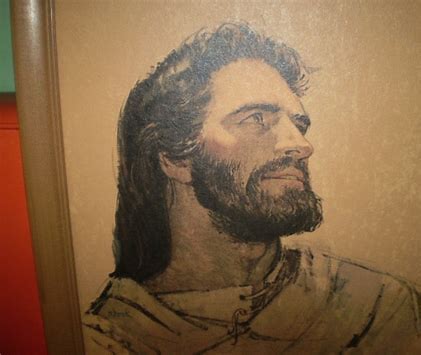
In the mid-sixties, a daring new portrait of Christ by Richard Hook began to circulate that was rugged, masculine and a little dirty from the road. It was just in time to become the image of Christ for the Jesus Movement. It was a refreshingly human portrayal after decades of familiarity with the Warner Sallman head of Christ from the 1940s. I was moved by it enough to write a song in 1968 called “Born to Die.”
Born to Die
by John Fischer
Dark clouds hide the sunlit sky
In the barn a baby cries
Does He know He’s born to die?
Rest now while your trials are few
Only your Father knows why
He was not a mighty king
He could make a hammer ring
Touch a heart and make it sing
His hands were the hands of strength
Hands that would pull men free
Bright sun tanned His weathered face
Dusty were the roads He traced
Spreading news of love and grace
Binding the broken heart
Soothing the sorrow-torn face
Dark clouds hide the sunlit sky
In the town a baby cries
On a hill a savior dies
Dies of His own free will
He can tell you why
My favorite part of this song has always been the last line, “He can tell you why.” Want to know why He had to die? Ask Him.
With that line this song joins a list of other Jesus Movement songs like “Welcome Back,” “Have You Seen Jesus My Lord,” and Larry Norman’s “Sweet Sweet Song of Salvation,” that indicate that the gospel is an invitation to know Jesus that is up to each of us to investigate and decide for ourselves whether we believe it or not. Jesus does not force His way into anyone’s life, but seeks a relationship with us via invitation. Knowing God is not predicated upon getting everything right. It’s all about coming to Jesus. Jesus will reveal Himself to you if you ask Him.







 John Fischer The Catch
Dear Pastor John ABSOLUETLY LOVED this song of yours! And the last two lines are awesome too!
Also, big Amen to this: “Knowing God is not predicated upon getting everything right. It’s all about coming to Jesus. Jesus will reveal Himself to you if you ask Him.”
That picture is so down to earth how it shows our Savior and people seeing that picture must feel so inspired like myself and Jesus appears so humbling like he wants to save all of us no matter what.
This portrait still hangs in my Mom’s living room!
How cool.
“Ask Him.”
So profound yet so simple.
Why do we even balk at talking to Him in such an easygoing manner?
Have we so quickly forgotten that He is with us wherever we are?
Do we not believe that we are His image, His reflection to all those around us?
Is He not the same yesterday, today, and forever?
As often is the case, the Catch stirred up memories of “hot topics” from not so long ago that, at the time, seemed relevant for one reason or another to either the Church in particular or society in general.
Awhile back there was great dispute and much haranguing from multiple Christian entities concerning an image, created by a Forensics Anthropologist, that showed what Jesus’ face may have actually looked like based on known details derived from archeological, cultural, and scientific analyses.
It looked nothing like what so many of us grew up with or envisaged and still causes controversy and even rancor.
Going back 60 years, the above painting in today’s Catch certainly fit those turbulent times as the fledgling Jesus Movement began emerging from the button-down Christianity of the previous generation.
The Richard Hook portrait presented a Jesus whose image looked more like the youth of the 60’s and, therefore, appeared more relatable to their ideologies and goals… perhaps with a twinge of rebellion from the former ways included.
The Warner Sallman painting, though, reflected a pragmatism and solemnity that mirrored and comforted our parents during their lives following the Great Depression… helping sustain them through the distressing times of World War II, the Cold War, and the conflicts in Asia.
In either case, both images of Jesus portray what we all yearn for: Peace.
Yes, it is always pleasant to see Jesus as this sort of humble “hunk” whose inner countenance displays a cross between Ward Cleaver and Atticus Finch (or for younger readers think maybe Chris Evans’ Steve Rogers and Samuel L. Jackson’s Nick Fury).
But then I have to remind myself:
“He had no stately form or majesty to attract us, no beauty that we should desire Him. He was despised and rejected by men, a man of sorrows, acquainted with grief.
Like one from whom men hide their faces, He was despised, and we esteemed Him not. He had done no violence, nor was any deceit in His mouth…”
~ Isaiah 53: 2-3, 9
So, what did Jesus look like?
What does He look like?
I like the thought that Albrecht Dürer (German painter 1471-1528) expressed through some of his artwork: Every Christian is an imitator (or image) of Jesus.
In other words, Jesus looks like you and me.
And you and I look like Him.
It’s pretty simple when you think about it. Just…
Ask Him.
–
I ran across this interesting documentary on how Jesus has been portrayed in art over the last two thousand years.
Even though we change, He is still the same yesterday, today, and tomorrow.
Shalom, Peace…
🙂
Bob … this is excellent. Mind if I share it with everyone?
I don’t mind.
If it helps, please do as you see fit.
By the way: Happy Father’s Day!!! 🙂
Very cool! And TY Bob in watching the video I felt like I was back in College taking my Art Appreciation class, which was an elective & I toughly enjoyed as I did watching this video!
You’re welcome, Mark.
I’m glad you enjoyed it!
Shalom, Peace my friend…
🙂