One more reason why church should be like an AA meeting

OIP-25

Let us, then, go to him outside the camp, bearing the disgrace he bore. Hebrews 13:13

“Hi, my name is John, and I’m a sinner.”

“Hi John!”

That’s the way church should begin. Before the Call to Worship; before the opening hymn — even the Invocation. Church should start with, “Hi, my name is John, and I’m a sinner,” to which the entire congregation responds in a resounding voice, “Hi John!” as if to say, “We get it, John. We’re sinners, too. You’re one of us! You’re at home here!”

Continue reading

Posted in Dealing with sin, grace, grace turned outward | Tagged , | 9 Comments

Lighthouse in a storm

download-5

These last few days have been very hard for Marti and me.  I find it difficult to think, sleep or care for her or anyone else, for that matter.  Our land is threatened and temporarily overtaken by the enemy. Unlike David in Psalm 41 and 42, I accepted the spirit of depression and did nothing to shake it. 

You see, late in David’s reign, his son, Absalom, took over the kingdom temporarily and David was driven into exile outside Jerusalem. Clearly it is a time of depression and frustration. But David does not give in to that spirit of depression, like I have a tendency to do; he seeks to do something about it. He embraces it, expresses it, and fights with it, as if he could wrestle it to the ground like Jacob wrestled with the angel.

None of us can escape times of depression; they will come. But when they come, instead of succumbing to them, we need to do what David did.  

There are three stages of David’s experience, and at the end of each stage there comes the refrain that describes what brought him through: 

“Hope in God; for I shall again praise Him, my help and my God.”

The first stage is one of intense longing and desire. He is experiencing a sense of God’s delay. There is no doubt in his heart that there is help for him in God. He expects to find it. He knows God has met his need in the past and he expects Him to meet it again. But, for some reason, after glorying in the memory specific times God has met his need, it still seems that help is delayed and this is hard for him to bear.

So he reminds himself in the refrain of this song:

Why are you cast down, O my soul,
  and why are you disquieted within me?
Hope in God; for I shall yet praise him,
  my help and my God. (Psalms 42:5)

But his trial is not over. He has reached a second stage and he tries another tactic. He says,

My soul is cast down within me,
  therefore I remember Thee
from the land of Jordan and of Hermon,
  from Mount Mizar.
Deep calls to deep
  at the thunder of Thy cataracts;
all thy waves and Thy billows
  have gone over me.
By day the Lord commands His steadfast love;
  and at night His song is within me,
a prayer to the God of my life. (Psalms 42:6-8)

Here he remembers something else: an experience on a mountain, where he heard the waterfalls and the thundering white water.  They seemed to be calling to one another, “deep calling unto deep,” and it reminded him that the depths in God call out to the depths in him: the depth of the love of God, and the joy of God, calling out to the corresponding depth of prayer in the believer. Even though he does not feel anything, they are there; these silent deeps in God calling out to the deeps in man. Depression can drive us deeper to where we can find God in the depths.

But still he is not met with any comfort or resolve. So he expresses his disappointment in Verses 9-10:

I say to God, my rock:
  “Why hast Thou forgotten me?
Why go I mourning
  because of the oppression of the enemy?”
As with a deadly wound in my body,
  my adversaries taunt me,
while they say to me continually,
  “Where is your God?” (Psalms 42:9-10)

As if to say “Well God, you heard them; where are you?”

He is still deeply troubled. His usual means for dispelling depression have not helped him this time. He has not been able to shake his sense of God’s untimely delay, and now it has grown into a nagging, torturing doubt, “Why hast Thou forgotten me?”

He has reached the place of despair. “Why have You abandoned me? I’ve taken refuge in You, God, and yet You do nothing, absolutely nothing. I feel utterly forsaken.”

But then he realizes, at last, a way out:

Oh send out Thy light and Thy truth;
  let them lead me,
let them bring me to Thy holy hill
  and to Thy dwelling!
Then I will go to the altar of God,
  to God my exceeding joy;
and I will praise Thee with the lyre,
  O God, my God. (Psalms 43:3-4)

What a word of triumph! Now he understands that what God is doing is driving him step by step to the ultimate refuge of any believer in any time of testing: the word of God. It is the truth of God coupled with the light that will lead Him. The truth is God’s word; the light is our understanding of it. What he is crying out for is an understanding of the word as he reads it; light, breaking out of these promises, to encourage and strengthen his heart. 

There comes a time in all of our lives when we discover for ourselves that our ultimate refuge is in the word of God — what God has said. That is what David is saying. When you have depression of spirit, where nothing seems to relieve it; when you have tried to remember a joyful time with God in the past, and tried to recall the unshakable, unchangeable relationship that exist between you and God, but nothing helps; then there is nothing left but to rest upon His word, His truth, and to allow that to heal your heart. 

So David isn’t actually able to wrestle his depression to the ground, but he is able to come to something even stronger than his depression — the truth and light of the word of God. Like a lighthouse in a storm, we can hold on through to calmer days.

So David closes once more with the refrain that catches up the whole meaning of this song:

Why are you cast down, O my soul,
  and why are you disquieted within me?
Hope in God; for I shall again praise Him,
  my help and my God.” (Psalms 43:5)

Yes, hope in God, for He is working out His purposes at all times. That is what the New Testament means when it says, “Having done all, to stand” (Ephesians 6:13).

Our Prayer Ministry Pastor, Merv Keck, has been a huge encouragement to me during this difficult time. Even his prayer requests are uplifting. As in: “Pray for financial stability as the ministry has labored through a pandemic during a time while many organizations did not stand.” And: “Pray that by the Grace of God we can focus our ministry on meeting the needs of a broken world, introducing Grace turned outward to everyone we encounter, and introduce Jesus to a new generation.”

Amen!

So why are you cast down O my soul? Hope in God; for I shall again praise Him, my help and my God!


Posted in Depressionj, pain | Tagged | 4 Comments

No enduring city

Man walking in abandoned futuristic city.

For here we do not have an enduring city, but we are looking for the city that is to come. Hebrews 13:14

Outside. Everything happens outside. Jesus died outside the camp. We go to meet Him outside the camp where He meets our disgrace with His grace. Once that’s happened and that grace has turned us outward toward others, why would we want to go back inside? Everybody’s out here. People inside already know, and they’re pretty much just sitting there. Outside is where the action is.

Continue reading

Posted in end times, grace turned outward | Tagged | 2 Comments

Where grace meets disgrace

download-4

And so Jesus also suffered outside the city gate to make the people holy through his own blood. Let us, then, go to him outside the camp, bearing the disgrace he bore. Hebrews 13:12-13

What happened?

According to this verse there is something disgraceful about meeting Jesus outside the camp. Did we miss something? Do you feel like you are walking around in a state of disgrace? I think we are trying everything we can to avoid disgrace.

Have we so bought into the American myth of success that we are attempting to “market” Christianity as helping make you wealthy, healthy, and successful, when none of that is guaranteed in the Bible? In fact, the truth is more likely to call us into failure in order to learn how to depend on Him. Failure is a far better teacher than success.

Continue reading

Posted in Dealing with sin, forgiveness, God's love, grace, the gospel | Tagged , , | 3 Comments

Breaking camp

OIP-23

We have an altar from which those who minister at the tabernacle have no right to eat. Hebrews 13:10

An altar is a place of slaughter. The lamb or bull that was brought in as a sacrifice for sin would be slain on the altar and the blood was spread around in various places as the priests were directed in the Law of Moses. The remainder of the blood was poured out at the base of the altar. Certain parts of the animal were designated as food for the priests, the rest was taken out and burned outside the camp. Only the priests were allowed to handle this activity.

Continue reading

Posted in Christianity and politics, Dealing with sin, forgiveness, the gospel | Tagged , | 3 Comments

Strengthened by grace

OIP-22

It is good for our hearts to be strengthened by grace. Hebrews 13:9

Have you ever thought of grace as strengthening you heart? I haven’t until I asked my wife about this and she said, “Oh yes! It’s my only hope.”

As often happens, I need to find out what she’s talking about. Marti’s secular understanding of God is often truer to the truth than my evangelical one.

Continue reading

Posted in grace, grace turned outward | Tagged , | 1 Comment

Time to go

26715D435477201B16

Let us, then, go to Him outside the camp, bearing the disgrace He bore. Hebrews 13:13

Disgrace – noun – a person or thing regarded as shameful or unacceptable

Are you willing to be regarded as shameful or unacceptable by anyone — even everyone — but God? 

So, let’s go. It’s time to leave the soft, protective environment that Christians have spent 50 years and billions of dollars creating and go out into the world, “outside the camp,” where Christ has been all along. Time for us to join Him.

Continue reading

Posted in Jesus Movement, revolution | Tagged , | 3 Comments

Grace, starring Jesus

OIP-21

Let us, then, go to him outside the camp, bearing the disgrace he bore. Hebrews 13:13

Here’s why it is so important for us to go outside the camp and bear the disgrace Jesus bore. Without that, people will get the wrong idea about us and about what a Christian is. 

Our lives are the canvas on which the gospel is painted. Will our picture tell the truth about ourselves, or will it lie? Will people see us as people like them who struggle, fail, do bad things, make mistakes and need forgiveness, or do they see us as a group that is too good to be part of? If you share in His disgrace, then grace makes sense. If you have no disgrace, then who needs grace? Christians who are doing just fine don’t have a message. Grace only makes sense to the disgraceful. 

Continue reading

Posted in grace turned outward | Tagged | 4 Comments

‘You really gotta get out more’

People-in-a-Bar

Thanks to Sandy, Toni, Gail, Nick, John, Liz, Lyn, Phillip, Merlyn, Bob, Lisa and Jill for their comments on yesterday’s Catch. As Phillip pointed out, we are all very busy and don’t always get to all our emails so that some people don’t respond just because they never saw it. I realize that, and that is why, when I think I have something very important for everyone to see, I will repeat it or mention it in subsequent emails. This is one of those times so if you haven’t read yesterday’s Catch, please do so, and please include your comments on line or to me privately by replying to any Catch sent to you by email.  Continue reading

Posted in Dealing with sin, grace, Worldview | Tagged , , | 4 Comments

Bearing the disgrace

drumul crucii 5

Let us, then, go to Him outside the camp, bearing the disgrace He bore. Hebrews 13:13

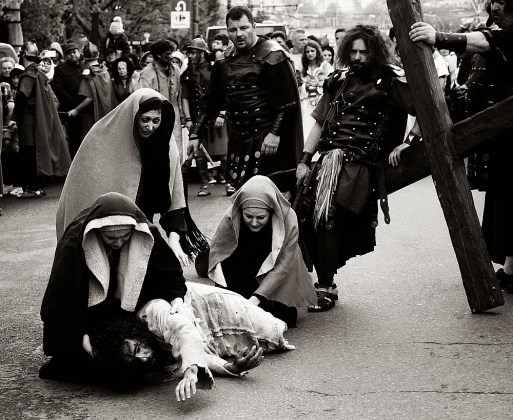
Here is just a part of the disgrace Jesus bore outside the camp:

He was crucified as a common criminal.

He was mocked, flogged and spit upon by the Roman soldiers.

He had no place to be buried until His body was claimed

The soldiers cast lots for His only possession: his robe.

He was ridiculed by the people.

He was powerless in His death.

He carried His own cross through the city before a jeering crowd. “Save yourself, Jesus! Where are your angels now, Jesus?”

(This part you couldn’t see except that it killed Him:) He became sin.

He was forsaken by His friends and followers.

He was forsaken by His Father.

He had all the look of a total loser.

Continue reading

Posted in grace turned outward, Hope | Tagged , | 18 Comments